German Shepherd Cost Guide
Veterinary care is one of the largest ongoing costs of owning a large-breed dog. For German Shepherds specifically, those costs tend to run higher than average because of the breed’s size, genetic predispositions, and the sheer volume of preventive care a 65–90 lb dog requires.
If you’re building a German Shepherd cost budget, the vet line item deserves serious attention. It’s not the most glamorous part of dog ownership, but it’s the one that catches people off guard most often. If you’re weighing coverage against paying out of pocket, the insurance estimator is the fastest way to see the tradeoff.
Routine Vet Costs
A healthy adult Shepherd visiting the vet once or twice a year can expect these baseline costs:
| Visit Type | Typical Range | Notes |
|---|---|---|
| Annual wellness exam | $50–$75 | Physical exam, weight check |
| Vaccinations (annual boosters) | $80–$150 | Rabies, DHPP, bordetella |
| Heartworm test | $35–$55 | Annual blood test |
| Fecal exam | $25–$45 | Parasite screening |
| Bloodwork panel | $100–$250 | Chemistry, CBC |
| Dental cleaning | $300–$700 | Under anesthesia, varies by region |
| Routine annual total | $600–$1,300 | Without dental, $300–$600 |
Dental cleanings are the wildcard. Some dogs need them annually by age five. Others go longer. The AVMA recommends regular dental assessments as part of routine care, and skipping them often leads to much costlier extractions later.
Breed-Specific Health Costs
This is where Shepherds diverge from the average dog. The breed carries higher-than-normal risk for several conditions that generate significant vet bills.
Hip and elbow dysplasia remain the most common orthopedic concerns. In a long-running analysis of the OFA registry (Oberbauer, Keller & Famula 2017; ~107,000 German Shepherd hip evaluations, 1970–2015), 18.9% of submitted hip radiographs were graded dysplastic, with 17.8% of elbow films affected. That is a submission-biased registry rate, not a population rate, but it places the breed among the most affected. Diagnostic imaging runs $200–$400. If surgery becomes necessary, total hip replacement is $5,600–$10,000+ per hip — the published figures genuinely split by source (MetLife near $5,600–$6,000, the University of Missouri $8,500–$10,000). If your Shepherd has started limping, the limping triage guide walks through how to tell hip from elbow from soft-tissue causes before the imaging bill lands.
Degenerative myelopathy (DM) is a progressive spinal cord disease with no cure. Diagnosis involves ruling out other conditions through MRI (a market-estimated $1,500–$3,000). The University of Missouri Canine Genetics Laboratory runs the SOD1 DNA test for $65 (single dog). Management costs are modest, but the diagnostic workup is not.
Bloat (GDV) is a life-threatening emergency. Surgery is a market-estimated $5,000–$7,000+ if caught in time, higher with ICU or tissue necrosis. There is no reliable German-Shepherd-specific lifetime GDV figure — the largest breed-risk study (Glickman et al. 2000) excluded the breed — but deep-chested dogs carry well-established elevated risk. Preventive gastropexy, often added during spay/neuter, is roughly $400–$800 combined (about $1,400–$2,500 standalone) and substantially reduces the torsion risk.
“Gastric dilatation-volvulus is one of the most serious non-traumatic emergencies seen in dogs, with mortality rates of 10–33% even with treatment.”
— Merck Veterinary Manual, Gastric Dilatation-Volvulus
Exocrine pancreatic insufficiency (EPI) affects Shepherds at higher rates than most breeds — the Merck Veterinary Manual names the German Shepherd as the most commonly affected breed (the often-quoted “~70% of canine EPI is GSDs” is a clinical estimate, not a controlled-study figure). Enzyme supplementation is required for life once diagnosed, and the cost scales with the dog’s size — budget a market-estimated $500–$3,000+ a year, and confirm with your vet.
What Do OFA and PennHIP Hip Screenings Cost?
Two different things get called “hip screening,” and they are priced differently.
OFA evaluation. Your own vet takes the radiographs under sedation and submits them to the Orthopedic Foundation for Animals, where a panel of radiologists grades them. The films are the bulk of the cost — a market-estimated $200–$400 including sedation, in line with any other set of hip radiographs. The registry evaluation fee itself is modest, well under $100 at the time of writing for hips, or hips and elbows submitted together. Final grades require the dog to be 24 months or older; earlier films are graded as preliminary.
PennHIP evaluation. This uses a different positioning protocol and produces a distraction index, a measure of joint laxity rather than a subjective grade. It must be performed by a vet trained and certified in the method, which limits where you can get it, and it typically runs a market-estimated $300–$600 all in. It can be performed from 16 weeks, which is why working-dog programs use it.
Most pet owners never need either. Screening exists for breeding decisions and for structured working programs, and a dog that is already limping needs diagnostic imaging aimed at the symptom instead, which the limping guide walks through. Where these numbers matter for a buyer is the other direction: a breeder charging breeder prices should have paid for these evaluations on both parents and should hand you the certificate numbers without being asked. Our guide to finding a reputable breeder covers how to verify what you are shown, and hip dysplasia prevention covers what you control after the puppy is home.
When Costs Spike
Vet bills don’t follow a straight line. They cluster around specific life stages and events.
Puppy year. The first twelve months are the most vet-intensive. Multiple rounds of vaccines, spay/neuter surgery, deworming, and frequent wellness checks push first-year vet costs to $800–$2,000. That’s before any surprises.
Ages 7–10. Senior bloodwork panels become important. Joint supplements often enter the picture. X-rays for arthritis monitoring add up. Annual vet spending for a senior Shepherd commonly hits $1,500–$3,000.
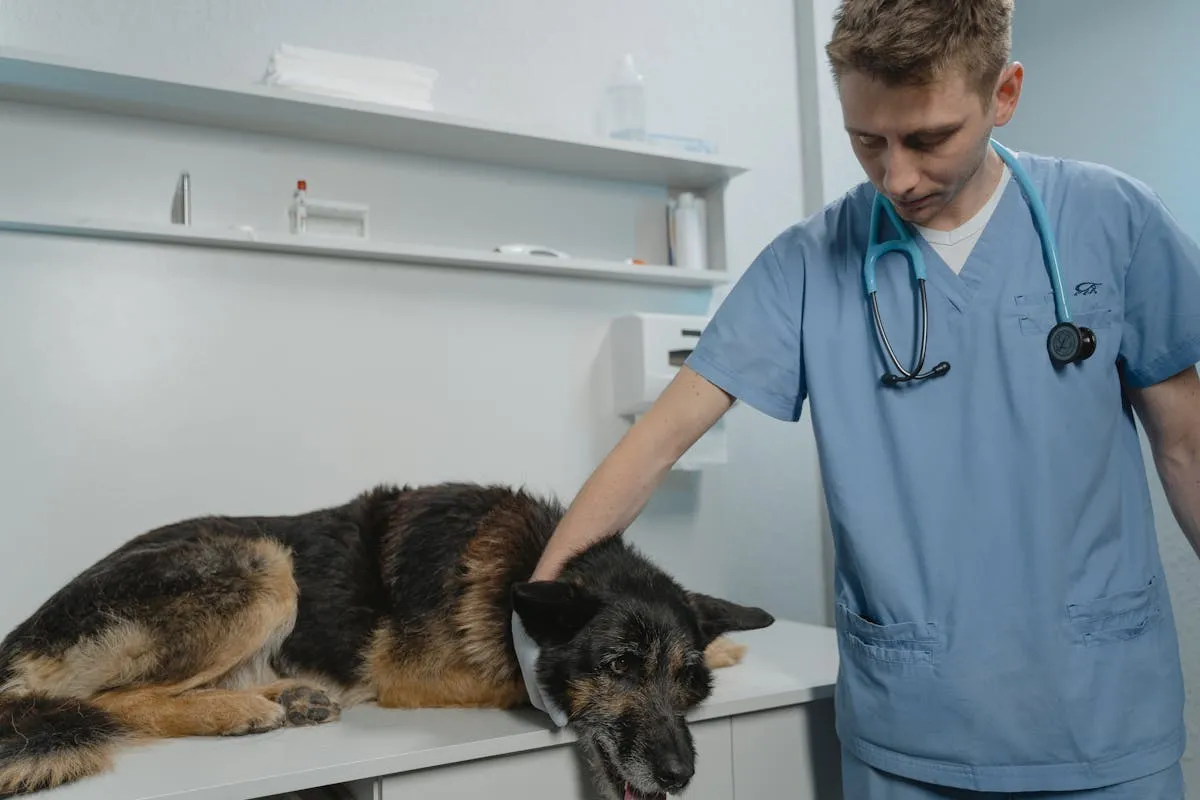
Emergency visits. An after-hours emergency clinic charges $150–$300 just for the exam, before any treatment begins. Foreign body ingestion, lacerations, or allergic reactions can easily generate bills of $1,000–$3,000 in a single visit.
Emergency Fund vs. Insurance
There are two main strategies for handling unexpected vet costs, and both have tradeoffs.
Pet insurance works best when purchased young, before pre-existing conditions enter the picture. The NAPHIA State of the Industry report put the average US accident-and-illness dog premium at $749.29 a year — about $62 a month — in 2024. There is no published German-Shepherd-specific premium figure, but the breed typically prices above that all-breed average; in practice owners report roughly $40–$120 a month depending on age, deductible, and coverage level. Most policies reimburse 70–90% of eligible costs after the deductible.
Self-insuring means setting aside money monthly into a dedicated savings account. Some owners prefer this because there are no exclusions, no claim denials, and no premium increases. The downside is obvious: a $5,000 emergency in year one wipes out the fund before it’s built.
For a breed with the health profile of a Shepherd, insurance tends to pencil out favorably over a lifetime, especially if purchased before age two.
How to Reduce Vet Costs Without Cutting Corners
Not all savings require compromise.
Wellness plans. Many vet clinics offer monthly wellness packages that bundle routine exams, vaccines, and bloodwork at a discount. These aren’t insurance. They cover predictable costs and can save 15–25% on routine care.
Preventive gastropexy. Adding this procedure during spay/neuter costs a fraction of emergency bloat surgery. For a deep-chested breed, it’s one of the highest-ROI preventive measures available.
Weight management. An overweight Shepherd puts more stress on already-vulnerable joints. Keeping your dog at a healthy weight reduces the likelihood and severity of hip dysplasia symptoms, arthritis progression, and associated vet visits. The Association for Pet Obesity Prevention estimates that over 55% of dogs in the US are overweight or obese.
Dental maintenance at home. Regular brushing and dental chews won’t eliminate the need for professional cleanings, but they can extend the interval between them. That’s $300–$700 saved each time you push a cleaning back by a year.
Lifetime Vet Cost Estimate
Over a 10–12 year lifespan, total veterinary spending for a Shepherd typically falls in these planning ranges (estimates, not quotes — regional pricing varies widely):
| Scenario | Lifetime Estimate |
|---|---|
| Healthy, no major issues | $8,000–$15,000 |
| One major surgery (ACL, bloat) | $12,000–$20,000 |
| Chronic condition (EPI, allergies) | $15,000–$25,000 |
| Multiple orthopedic issues | $20,000–$35,000 |
These numbers assume US pricing. Costs vary significantly by region. Urban clinics in the Northeast and West Coast tend to run 20–40% higher than the national average.
Disclaimer: Cost estimates are approximations based on publicly available data. Actual costs vary significantly by location, provider, and individual circumstances. Read full disclaimer →
Follow new work
A new guide every week or so.
Roughly one new guide every week or so. Cost data, feeding research, breed health — sourced and dated. By Sam, in Belgium.
Related Articles

Best Pet Insurance for German Shepherds
A practical comparison of pet insurance options for German Shepherd owners. What to look for, what to watch out for, and how to choose a plan that fits.
Annual Cost of Owning a German Shepherd
Itemized annual cost breakdown for German Shepherd ownership. Food, vet care, insurance, grooming, and extras with real 2026 numbers and sourced estimates.

German Shepherd Common Health Problems and Costs
Every major health condition German Shepherds face, how common each is, and what treatment typically costs. Real data from OFA, Nationwide, and vet sources.