German Shepherd Breed Guide
On this page · 13 sections
- 01What Makes European Show Lines Different
- 02Physical Characteristics
- 03The Sloped Back Question
- 04Temperament and Working Ability
- 05Health Testing: SV vs. AKC
- 06How Much European Show Lines Cost
- 07Finding a Reputable Breeder
- 08European Show Line vs. Other Lines
- 09Who Should Get a European Show Line
- 10The SV Show Rating System
- 11Exercise and Training Needs
- 12Common Health Concerns
- 13Breed Standard and Research Sources
If you have spent any time looking at Shepherds from European breeders, you have probably noticed they look and move differently from the dogs you see at AKC shows in the United States. That is not a coincidence. European show lines come from an entirely different breeding system, one that requires every dog to prove it can work, pass health screening, and demonstrate stable temperament before it is ever bred.
The result is a dog that looks athletic without being exaggerated, has enough drive to do real work, and comes with independently verified health credentials. Living in Belgium, I see these dogs constantly at local clubs and shows. They are the default here, and for good reason. But they are not for everyone, and they are not cheap.
What Makes European Show Lines Different
The term “European show line” refers specifically to West German show line German Shepherds bred under the rules of the SV (Verein für Deutsche Schäferhunde), the original breed club founded in 1899. The SV operates under the FCI (Fédération Cynologique Internationale), which sets the international breed standard used in every country except the United States and a handful of others that follow the AKC.
The distinction is not really about geography. It is about the breeding system itself.
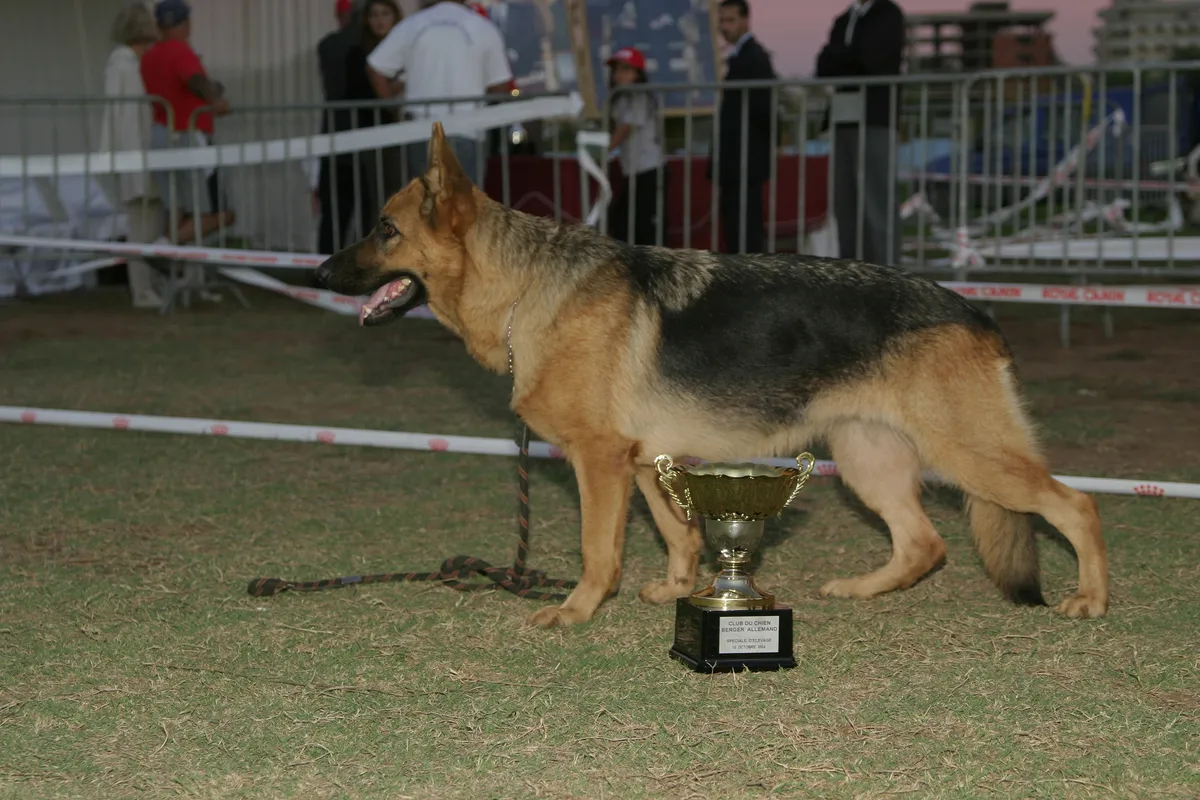
Before an SV-registered Shepherd can produce a litter, it must have:
- IGP 1 title minimum (formerly Schutzhund/IPO), a three-phase test covering tracking, obedience, and protection work
- BH (Begleithund) companion dog temperament test
- AD (Ausdauerprüfung) endurance test covering roughly 12.5 miles at a trot
- Certified hips and elbows (SV a-stamp system, where only grades a1, a2, or a-normal qualify)
- Körung (breed survey) that evaluates structure, temperament, and nerve strength under pressure
No dog enters the breeding pool based on looks alone. That single fact separates European show lines from American show lines, where the AKC requires no health testing, no working title, and no temperament evaluation for breeding stock.
“The breed survey (Körung) is the ultimate instrument used as the selection method for the German Shepherd Dog Breed.”
— United Schutzhund Clubs of America (USCA)
Physical Characteristics
European show lines are built to move. The SV standard describes a medium-sized dog, slightly longer than tall, with a body built for efficient, ground-covering trot.
| Trait | Males | Females |
|---|---|---|
| Height at withers | 60–65 cm (23.5–25.5 in) | 55–60 cm (21.5–23.5 in) |
| Weight (typical) | 30–40 kg (66–88 lbs) | 22–32 kg (49–71 lbs) |
| Chest depth | 45–48% of withers height | 45–48% of withers height |
| Body proportion | 10–17% longer than tall | 10–17% longer than tall |
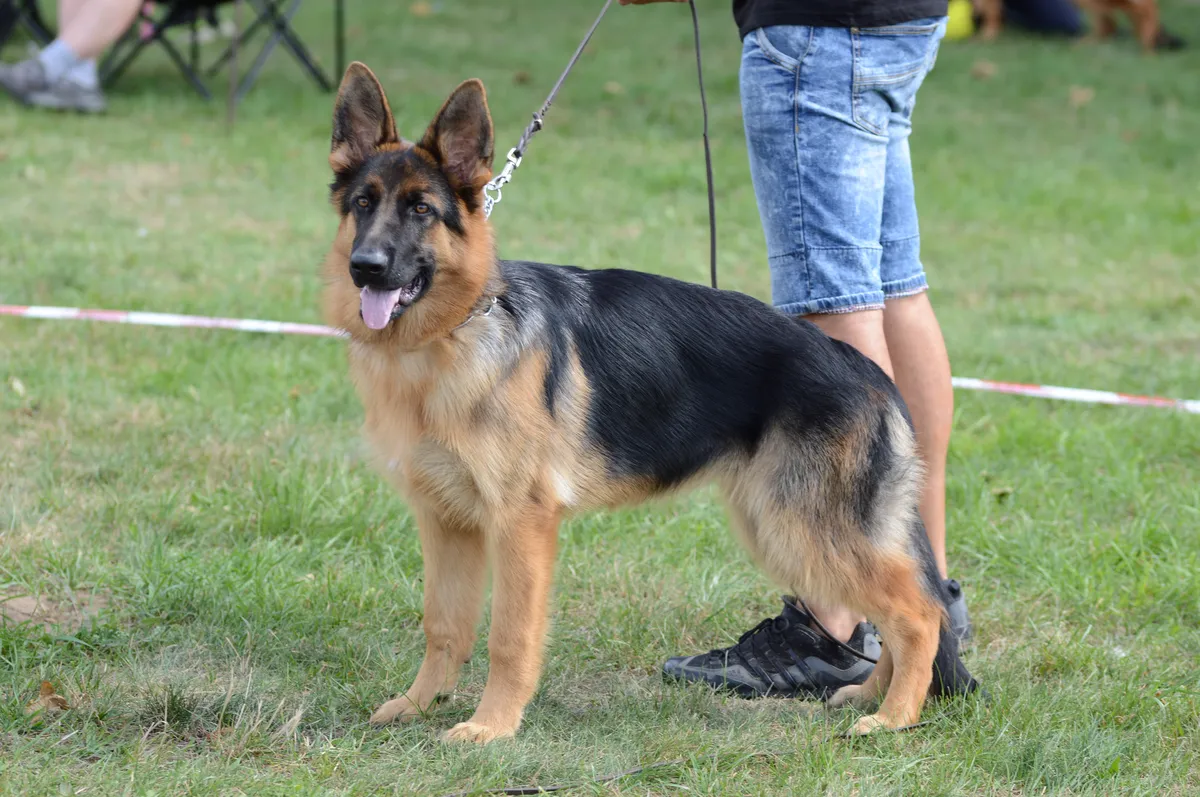
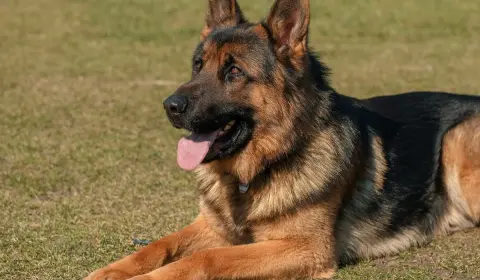
Coloring. The classic European show line look is a rich black and red saddle-back pattern. Deep, saturated pigmentation is strongly preferred in the SV ring. Black and tan, solid black, and sable are also accepted. White, blue, and liver are disqualifying faults under the FCI standard.
Bone and build. Heavier bone than American show lines, with broader heads and more muscular development. They look substantial without being bulky. The overall impression should be athletic and balanced.
Angulation. European show lines have more pronounced rear angulation than working lines, but less extreme than American show lines. The shoulder blade and upper arm ideally form roughly a 90-degree angle. Rear angulation sits around 120 degrees between upper and lower thigh.
Gait. This is where the SV ring really separates dogs. At Sieger shows and regional breed shows, dogs are gaited at a trot for extended periods. Sometimes 20 minutes or more. The judge is evaluating endurance, soundness, and that effortless ground-covering movement the breed is known for. A dog that tires or breaks gait is immediately obvious.
The Sloped Back Question
This comes up constantly, so let’s address it directly.
The SV breed standard calls for a straight back flowing from the withers, through the back, to a slightly sloping croup at approximately 23 degrees. The back itself should not be roached or curved. What people perceive as a “sloped back” is mostly the croup angle combined with the show stack stance, where the handler positions one rear leg further back to emphasize the topline.
The criticism is not entirely unfounded, though. Some show breeders have pushed rear angulation beyond what the standard actually requires, chasing a more dramatic side gait. The 2016 Crufts controversy, where a German Shepherd named Cruaghaire Catoria won Best of Breed but was visibly struggling to walk, became a flashpoint for this debate. The Kennel Club later acknowledged the dog should not have won.
A well-bred European show line from a breeder who follows the standard rather than exaggerating it should have a functional, balanced topline. When evaluating breeders, watch the dogs move freely off-leash. That tells you more than any stacked photo.
For more on how structure and health connect in the breed, see our guide to breed characteristics.
Temperament and Working Ability
The SV system shapes temperament through requirements, not just preference. Because every breeding dog must earn an IGP title, the line retains genuine working ability. These are not purely decorative animals.
Nerve strength is the defining trait. The standard requires dogs that are “well-balanced, firm in nerves, self-confident, absolutely calm and impartial.” In practice, this means a dog that stays composed in new situations, recovers quickly from startling stimuli, and does not default to fear or aggression under pressure.
Drive level sits in a middle range. European show lines have less raw intensity than DDR or Czech working lines but significantly more drive than American show lines. They can track, do obedience, and perform controlled protection work. They also settle in the house and do not bounce off the walls between training sessions.
This balance is why many families consider them the most livable of the five lines. Enough drive to be engaged and trainable. Enough calm to coexist with daily life. The temperament profile is predictable because the breeding system tests for it rather than hoping for it.
But “calm for a working breed” still means a dog that needs structured activity. A European show line left alone in a yard with nothing to do will develop behavioral problems just like any other Shepherd.
Health Testing: SV vs. AKC
This is where the breeding systems diverge most dramatically.
| Requirement | SV (European) | AKC (American) |
|---|---|---|
| Hip certification | Mandatory (a-stamp) | Voluntary (OFA) |
| Elbow certification | Mandatory | Voluntary |
| Working title | Mandatory (IGP 1+) | None |
| Temperament test | Mandatory (BH + Körung) | None |
| Endurance test | Mandatory (AD, 12.5 mi) | None |
| Breed survey | Mandatory for full approval | No equivalent |
| Breeding restriction for failures | Yes, dogs with a4/a5 hips cannot breed | No restriction |
The SV hip grading system uses six grades. Only a1 (normal), a2 (near-normal), and a-normal (still acceptable) qualify a dog for breeding. Dogs graded a4 or worse are excluded entirely. This is mandatory and enforced. No exceptions.
Under the AKC system, the Orthopedic Foundation for Animals (OFA) provides voluntary screening. Submission is optional, results are advisory, and no breeding restriction exists regardless of outcome. According to OFA data, approximately 20% of German Shepherds evaluated between 1974 and 2015 showed evidence of hip dysplasia. That figure likely understates the real prevalence because owners with bad results often do not submit them.
Does mandatory screening eliminate hip problems? No. But decades of only breeding dogs that pass has reduced the incidence in screened European populations compared to unscreened ones. Honestly, it is the single strongest argument for paying the premium that these dogs command.
Hip dysplasia treatment can run into the thousands, which makes the upfront investment in health-tested breeding stock look more reasonable.
How Much European Show Lines Cost
European show lines are the most expensive of the five lines. The price reflects what it actually costs to breed responsibly under the SV system.
| Category | Typical US Price |
|---|---|
| Pet quality from titled parents | $3,500–$6,500 |
| Show/breeding quality | $5,000–$8,000 |
| Top quality from VA-rated bloodlines | $6,500–$10,000+ |
| Imported adult with titles | $8,000–$25,000+ |
That premium covers hip and elbow x-rays for both parents, IGP training and titling (which takes months to years), show entry fees, breed survey costs, and often import fees for European bloodlines. A breeder cutting corners on any of those steps should not be charging show-line prices.
The purchase price is a fraction of what you will spend over the dog’s life. Our first-year cost breakdown covers the full picture. Starting with a health-tested dog from a proven breeding program can save significant veterinary costs later.
Finding a Reputable Breeder
The breeding system only works if the breeder actually follows it. Here is what to verify.
Non-negotiables:
- Hip and elbow certifications on both parents (a1 or a2 preferred)
- IGP titles on both parents (IGP 1 minimum, IGP 2 or 3 is better)
- Körung (breed survey) on at least one parent, ideally both
- KKL1 rating (“especially recommended for breeding”) is the gold standard
- AD endurance test completed
- SV show rating of V (Excellent) or higher
Strong signals:
- Breeder competes with their own dogs in show or sport
- Willingness to show full pedigree going back several generations
- Health guarantee with a mandatory return clause
- They ask you questions about your home, experience, and plans for the dog
- Socialization protocol for puppies before they go home
Red flags:
- No health clearances or evasive about documentation
- Selling puppies under 8 weeks
- Multiple litters available at all times
- Breeding primarily for “rare” colors
- No questions about your suitability as an owner
- Prices significantly below market (suggests corners being cut on health testing)
Our detailed guide on how to find a reputable breeder covers the vetting process in more depth. The USCA (United Schutzhund Clubs of America) maintains a breeder directory that is a reasonable starting point, though inclusion alone does not guarantee quality.
European Show Line vs. Other Lines
If you are deciding between lines, here is how European show lines compare on the traits that matter most for daily life.
| Trait | European Show | American Show | Working Lines |
|---|---|---|---|
| Energy level | Moderate-high | Moderate | High-very high |
| Drive intensity | Medium | Low-medium | High |
| Trainability | Very high | High | Very high |
| Health screening | Mandatory | Voluntary | Mandatory (SV) |
| Family suitability | Excellent | Very good | Good (experienced owners) |
| Exercise needs | 60–90 min/day | 45–60 min/day | 90+ min/day |
| Typical price (US) | $3,500–$8,000 | $1,500–$2,500 | $1,500–$3,500 |
European show lines sit in the middle ground. More drive and structure verification than American show lines. More manageable for family life than Czech or DDR working lines. If you want a Shepherd with proven health, stable temperament, and enough working ability to do sport or protection training without the intensity of a dedicated working dog, this is typically the line that fits.
For a full breakdown of all five lines, see our complete comparison guide.
Who Should Get a European Show Line
Good fit:
- Active families who can provide 60 to 90 minutes of daily exercise
- Owners interested in dog sport (IGP, rally, agility, tracking)
- People who value health-tested, temperament-verified breeding
- Families with older children who want a protective but social companion
- Owners who plan to invest in training from the start
Not ideal for:
- Sedentary households or people away from home 10+ hours daily
- Owners looking for the lowest purchase price
- People who want a purely decorative or low-energy companion
- First-time dog owners who do not plan to invest in training (though committed first-timers who will put in the work can do well)
The question is not whether European show lines are “better” than other types. It is whether the traits this line was selected for match the life you will give the dog.
The SV Show Rating System
If you are reading pedigrees or breeder websites, you will encounter SV-specific ratings. Here is what they mean.
| Rating | German | Meaning | Requirements |
|---|---|---|---|
| VA | Vorzüglich-Auslese | Excellent Select | Only at BSZS Sieger Show; IGP 2+ |
| V | Vorzüglich | Excellent | 2+ years, hip cert, working title, endurance test |
| SG | Sehr Gut | Very Good | Highest for dogs under 2 or missing requirements |
| G | Gut | Good | Lowest rating allowing breeding in Germany |
VA1 is the World Sieger (Champion), awarded to one male and one female each year at the Bundessiegerprüfung (BSZS) in Germany. Dogs from VA-rated parents command the highest prices because the rating represents the pinnacle of the SV evaluation system.
A V rating on both parents is what most serious breeders aim for. It confirms the dog has been evaluated for structure, gait, health, temperament, and working ability. SG is respectable for younger dogs still working toward full credentials. A G rating is the bare minimum for breeding approval.
Exercise and Training Needs
These dogs were bred to trot for 12.5 miles and then do protection work. They are not couch dogs.
Plan for 60 to 90 minutes of daily physical exercise. That can be split between walks, off-leash running, fetch, swimming, or structured sport training. Variety matters. The same loop around the block every day will bore a smart Shepherd pretty quickly.
Mental stimulation matters just as much. Obedience work, scent games, puzzle feeders, learning new skills. These dogs were selected for their ability to learn and problem-solve, and they get bored faster than most people expect. If you do not give them appropriate outlets, they will find their own. Usually involving furniture.
Puppies and adolescents need carefully managed exercise to protect developing joints. Adults need consistency and challenge. Our exercise needs guide sets the daily targets by age.
Common Health Concerns
Mandatory screening reduces but does not eliminate genetic health risks. The conditions worth knowing about:
- Hip dysplasia. The most discussed concern. SV screening has reduced prevalence in tested populations, but the breed remains predisposed, and our hip dysplasia prevention guide covers what an owner can still influence after purchase. According to OFA data, roughly 18% of German Shepherds born between 2011 and 2015 showed evidence of hip dysplasia on voluntary screening.
- Elbow dysplasia. Less discussed but significant. Also covered by mandatory SV screening.
- Degenerative myelopathy (DM). A progressive spinal cord disease affecting roughly 2% of the breed. A DNA test is available and responsible breeders screen for it.
- Bloat (GDV). Deep-chested breeds like Shepherds are at higher risk. Not related to line type. Feeding practices and preventive gastropexy can reduce risk.
- Osteoarthritis. Common in older dogs, particularly those with even mild joint dysplasia earlier in life.
Typical lifespan is 10 to 13 years.
“German Shepherd Dogs had significantly higher risk of hip dysplasia than Dobermanns, Labradors and Rottweilers.”
— Demographics of Canine Hip Dysplasia, PLoS One (2017)
Breed Standard and Research Sources
- Verein für Deutsche Schäferhunde (SV). Körung (breed survey) requirements, breeding regulations, and a-stamp hip/elbow certification system.
- Fédération Cynologique Internationale (FCI). Standard No. 166, German Shepherd Dog, including 2010 coat variety amendment.
- United Schutzhund Clubs of America (USCA). Breed survey regulations and breeding requirements.
- Orthopedic Foundation for Animals (OFA). Hip dysplasia statistics for German Shepherds, 1974–2015 evaluation data.
- Wahl et al. (2017). “Demographics of Canine Hip Dysplasia in the Republic of Ireland.” PLoS One.
- American Kennel Club (AKC). German Shepherd Dog breed standard.
Follow new work
A new guide every week or so.
Roughly one new guide every week or so. Cost data, feeding research, breed health — sourced and dated. By Sam, in Belgium.
Related Articles
German Shepherd Breed Characteristics
Complete guide to German Shepherd breed characteristics: AKC size standards, temperament, intelligence ranking, coat types, health, and family suitability.
History of the German Shepherd Breed
From Max von Stephanitz and Horand von Grafrath in 1899 to today's most versatile working breed. The complete history of the German Shepherd Dog breed.
Types of German Shepherds: 5 Breed Lines Compared
Five distinct German Shepherd lines exist, from American show dogs to DDR border patrol stock. Compare build, temperament, health, and price for each type.