German Shepherd Breed Guide
Your Shepherd has had an hour-long walk, a training session, and a frozen Kong. It is 8pm. And the dog is still pacing the living room, following you room to room, whining at nothing, unable to just lie down and be still.
This is one of the most frustrating behavior patterns Shepherd owners deal with. The dog has the physical capacity to settle. He has had enough exercise. But he does not know how to turn off. Nobody taught him.
Calm is a skill. For most breeds, it comes somewhat naturally. For Shepherds — bred to be alert, engaged, and working at all times — it has to be learned.
Why Shepherds struggle with this
The breed was designed to be “on” for extended periods. Herding, guarding, patrolling. The default state is vigilant, not relaxed. When there is no job to do, the dog does not switch to idle. He looks for a job. And if he cannot find one, pacing the house and monitoring your movements becomes the job.
Three factors make indoor settling particularly hard for the breed:
Handler awareness. Shepherds track their person constantly. Where you are, what you are doing, whether you are about to leave. This hyper-awareness means the dog never fully disengages, because he is always monitoring.
Low boredom threshold. A Shepherd with nothing to do is a Shepherd in distress. The breed needs mental engagement. Without it, the restless behavior is not disobedience — it is a dog that cannot cope with inactivity.
Arousal that does not self-regulate. Some dogs get wound up and come back down on their own. Many Shepherds do not. Once the arousal level goes up (a walk, a visitor, a sound), it stays elevated for a long time. The dog does not have an internal mechanism to bring it back down.
Rule out medical causes first
Before treating this as a training problem, make sure it is not a health problem.
Sudden onset restlessness in a previously calm dog can indicate pain (hip dysplasia, joint inflammation, digestive discomfort), thyroid issues, liver disease, or in older dogs, cognitive dysfunction. If your adult Shepherd was calm for years and suddenly cannot settle, a vet visit is the right first step.
The three-part solution
Settling requires three things working together. Exercise alone is not enough. Training alone is not enough. You need all three.
The three parts that work together
| Part | What it is | Why it matters | Time investment |
|---|---|---|---|
| 1. Physical + mental baseline | 90-120 min daily activity + 1+ daily mental stimulation session (training, nose work, puzzle). | Without unspent energy disposed of first, no training overrides the physical discomfort of an under-exercised Shepherd. | 1.5-2 hours/day. Non-negotiable. |
| 2. Capturing calmness | Mark and reward voluntary settles throughout the day. No commands, no setup. | Teaches the dog that choosing to be calm is rewarding. Reverses the default pattern where activity gets attention and calm gets ignored. | Zero extra time. Just shift attention. |
| 3. Mat training (Overall protocol) | Structured 15-day daily program teaching down-stay on a mat through escalating distractions. | Installs a portable off-switch cue. The mat becomes the answer to “what should I do when there’s nothing to do.” | 10-15 min/day for 15 days, then maintenance. |
Part 1: Meet the physical and mental baseline
Before any calm-training works, the dog’s needs have to be met. For most adult Shepherds, that means:
- 90 minutes to 2 hours of physical activity daily, split into two sessions
- At least one mental stimulation session: training, nose work, puzzle feeders, or structured play
- Adequate nutrition to support recovery
If the dog’s needs are not being met, no amount of “place” training will override the physical discomfort of unspent energy. Meet the baseline first. Then train the calm.
Part 2: Capturing calmness
This is the most powerful technique for teaching a dog to settle, and it requires zero extra time.
How it works: Throughout the day, watch for moments when your dog voluntarily lies down or relaxes. The moment it happens — the dog sighs, puts his head on his paws, lies on his side — quietly say “good” and toss a treat nearby. Do not get excited. Do not call the dog over. Just mark and reward the calm behavior where it happens.
What it teaches: The dog learns that choosing to be calm is rewarding. Over time, he offers calm behavior more frequently because it gets reinforced. You are not commanding calm. You are reinforcing a choice.
Common mistake: Most owners do the opposite. They ignore the dog when he is quiet and engage when he is active. The dog learns that activity gets attention and calm gets nothing. Flip that pattern.
Start with 5-10 captures per day. Within 2-3 weeks, most dogs start defaulting to calm behavior more often.
Part 3: Mat training (the Relaxation Protocol)
Dr. Karen Overall’s Relaxation Protocol is a structured 15-day program that teaches a dog to relax on a mat regardless of what is happening around it. It is the gold standard for teaching the “off switch.”
The basics:
- Choose a mat, bed, or towel. This becomes the dog’s “place.”
- Lure the dog onto the mat. Mark and reward for lying down on it.
- Gradually add duration. Reward the dog for staying on the mat for 5 seconds, 10 seconds, 30 seconds.
- Add distractions. Step away. Clap your hands. Open the fridge. Pick up your keys. Reward the dog for staying on the mat through each distraction.
- Add real-life scenarios. Doorbell. Visitor entering. You moving to another room.
The full protocol takes 15 days of short daily sessions. By the end, the dog has a portable “off switch” — you can send him to his mat in any situation and he knows the job is to lie there and relax.
“The goals of this program are to teach the dog to relax, to defer to you, and to develop a foundation for future behavior modification.”
— Dr. Karen Overall, DVM, PhD, DACVB, Protocol for Relaxation (2013)
Where to use it: Before meals, during video calls, when visitors arrive, in the evening when you want the dog to settle. The mat becomes the answer to “what should I do when there is nothing to do.”
How much sleep does a German Shepherd need?
More than most owners expect. Commonly cited estimates for adult dogs land around 12 to 14 hours in a 24-hour period, counting naps rather than one continuous block. Puppies need far more — 16 to 20 hours — and senior dogs drift back upward. A dog that is genuinely getting that much rest is a very different animal from one running on nine or ten.
This is the part that catches people out, because sleep debt in this breed does not look like tiredness. It looks like the opposite. An under-rested Shepherd gets faster, louder, mouthier, and less able to disengage from anything. The signs are the same ones that send owners looking for more exercise: pacing, grabbing objects, barking at nothing, an inability to lie down for more than a minute. Adding a second walk to that dog makes it worse.
Count the hours before you change the routine. If the household is busy from 6am to 11pm, with people coming and going and a dog that tracks every movement, the dog may be physically lying down for plenty of hours without ever properly sleeping. A crate or a quiet room out of the traffic flow, used deliberately in the middle of the day, often does more for settling than any training exercise on this page.
Enforced downtime
Some Shepherds genuinely do not know how to stop. They will keep going until they overstimulate themselves into a frenzy. For these dogs, you need to create the conditions for rest.
After exercise, put the dog in a quiet area with a long-lasting chew or Kong. Use a crate, baby gate, or closed door if needed. The dog is not being punished. He is being given a framework to decompress.
The routine matters. Exercise → enrichment → enforced rest. The dog learns the pattern: activity is followed by calm, and calm is followed by more activity. The predictability itself is calming.
The evening zoomies problem
What realistic progress looks like
Capturing calmness + mat protocol timeline
| Week | What you see |
|---|---|
| Week 1 | Start capturing calm. Dog is confused at first — why is he getting treats for doing nothing? Starts lying down more often. |
| Week 2 | Begin mat training. Dog holds down-stay on mat for 30 seconds with minimal distraction. |
| Week 3-4 | Mat duration increases. Dog starts going to the mat on his own. Evening restlessness decreases. |
| Month 2-3 | Functional off-switch. Dog settles for 30-60 min after exercise without constant management. Default state shifts from restless to calm. |
What Settling Looked Like in Practice
The dogs I’ve raised that settled best as adults were the ones whose owners captured calmness from puppyhood. The dogs that struggled longest were the ones whose owners engaged most when the dog was excited — and inadvertently taught the breed that high arousal was what produced attention. The off-switch is real. It just has to be installed.
For related challenges, see our guides on when Shepherds calm down by age, exercise needs, and separation anxiety.
Sources
- Protocol for Relaxation ↗ 15-day relaxation protocol — the evidence-based mat-training framework.
- Capturing Calmness ↗ Foundational reference for the 'mark voluntary calm' technique.
- Canine Cognitive Dysfunction Syndrome ↗ Sudden-onset restlessness in senior dogs — rule out before training.
- Find a Veterinary Behaviorist ↗ Referral path for anxiety-driven inability to settle.
- Position Statement on Humane Dog Training ↗ Reward-based approaches for behavior modification including off-switch training.
Follow new work
A new guide every week or so.
Roughly one new guide every week or so. Cost data, feeding research, breed health — sourced and dated. By Sam, in Belgium.
Related Articles

German Shepherd Exercise Needs by Age
German Shepherd exercise needs from puppy to senior — how much daily activity at each life stage, what kind, and the mistakes most owners make.

German Shepherd Separation Anxiety — Signs and Solutions
Why German Shepherds get separation anxiety and how to fix it. Covers signs, severity levels, a step-by-step protocol, and a schedule for working owners.
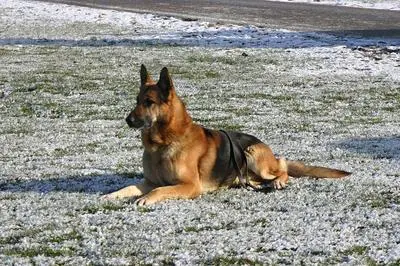
When Do German Shepherds Calm Down?
When German Shepherds actually calm down — by age and phase, what to expect at each stage, and the daily-life choices that meaningfully speed it up.