Best German Shepherd Food
German Shepherd puppies grow at a pace that catches most new owners off guard. A 15-pound furball at eight weeks can triple in size by four months. The chart below lays out month-by-month weight ranges for males and females, drawn from AKC breed standard data and veterinary growth references.
Use it as a reference, not a rulebook. Your dog’s genetics, lineage, and diet all play a role. Pair this chart with a proper feeding schedule to make sure portions match each growth stage.

Expected Weight and Height by Age
| Age | Male Weight (lbs) | Male Height (in) | Female Weight (lbs) | Female Height (in) |
|---|---|---|---|---|
| 1 month | 5.5–9 | 5–6 | 4.5–8 | 4–5 |
| 2 months | 16–20 | 9–11 | 11–17 | 8–10 |
| 3 months | 22–30 | 12–14 | 17–26 | 11–13 |
| 4 months | 35–40 | 14–17 | 31–35 | 13–16 |
| 5 months | 40–49 | 16–19 | 35–44 | 15–18 |
| 6 months | 49–57 | 18–21 | 44–49 | 17–20 |
| 7 months | 57–62 | 19–22 | 49–53 | 18–21 |
| 8 months | 62–66 | 20–23 | 53–57 | 19–22 |
| 9 months | 64–71 | 21–24 | 55–60 | 20–23 |
| 10 months | 66–73 | 22–25 | 57–62 | 21–24 |
| 11 months | 66–75 | 23–26 | 58–64 | 22–25 |
| 12 months | 71–79 | 24–26 | 60–64 | 22–24 |
| 18 months | 71–84 | 24–26 | 60–66 | 22–24 |
| 24 months (adult) | 65–90 | 24–26 | 50–70 | 22–24 |
Height is measured from paw pads to the top of the shoulder blade (withers), not the head.
Source: AKC breed standard + midpoints of the ranges in the table above
The steepest stretch of either line is the 2-to-6-month window the breed is known for. After nine months both curves flatten, and the male-female gap that opened around three months holds for the rest of the dog’s life.
How to Use This Chart
Find your puppy’s age in the left column and compare their weight and height to the range for their sex. A few pounds or an inch above or below is perfectly normal. Shepherds grow in spurts, so a pup might plateau for two weeks and then jump several pounds overnight.
The trend matters more than hitting an exact number. Steady, gradual gains month over month are a good sign. Sudden stalls or rapid spikes are worth watching.
AKC breed standard: Adult males should weigh 65–90 pounds and stand 24–26 inches at the shoulder. Adult females should weigh 50–70 pounds and stand 22–24 inches. — American Kennel Club
How Fast German Shepherds Grow at Each Stage
Growth is not evenly paced. The rate changes sharply as your Shepherd matures.
| Stage | Age | Typical Monthly Weight Gain | What’s Happening |
|---|---|---|---|
| Rapid growth | 2–6 months | 8–10 lbs/month | Skeletal growth at its peak. Height increasing fast. |
| Steady growth | 6–9 months | 4–6 lbs/month | Growth rate slowing. Muscle development picks up. |
| Filling out | 9–12 months | 2–4 lbs/month | Near adult height. Adding chest depth and muscle. |
| Final maturation | 12–24 months | 0–2 lbs/month | Subtle changes. Frame thickening, muscle definition. |
The 2-to-6-month window is where most of the dramatic change happens. A male can go from 16 pounds to nearly 60 in that stretch. After nine months, the visible changes slow down, but internal development — bone density, joint maturation — is still underway.
Male vs. Female Size Differences
Males grow faster and heavier through every stage, often putting on 8–10 pounds per month through the first six months. The final 10–15 pounds fill in gradually between 12 and 24 months.
Females follow a similar curve but run about 10–15 pounds lighter at each stage. They tend to reach adult height sooner and finish filling out between 18 and 24 months, while some males keep adding mass until closer to 30 months.
Working Line vs. Show Line Weight Ranges
The chart above reflects the breed as a whole, but lineage creates real variation. Knowing your dog’s background helps set realistic expectations.
Working lines (Czech, DDR, Belgian ring sport) are bred for function. These dogs tend to be leaner, lighter-boned, and more compact. A healthy adult male from working lines might weigh 65–80 pounds. That’s not underweight. It’s build.
Show lines (West German SL, American show) carry more angulation, deeper chests, and heavier bone. Males from European show lines regularly hit 80–90 pounds. American show lines can vary more widely.
If your Shepherd comes from a breeder, ask what the parents weigh. That gives you a better target than any generic chart. If you adopted or rescued, the chart ranges still work as a general guide, but expect more variation.
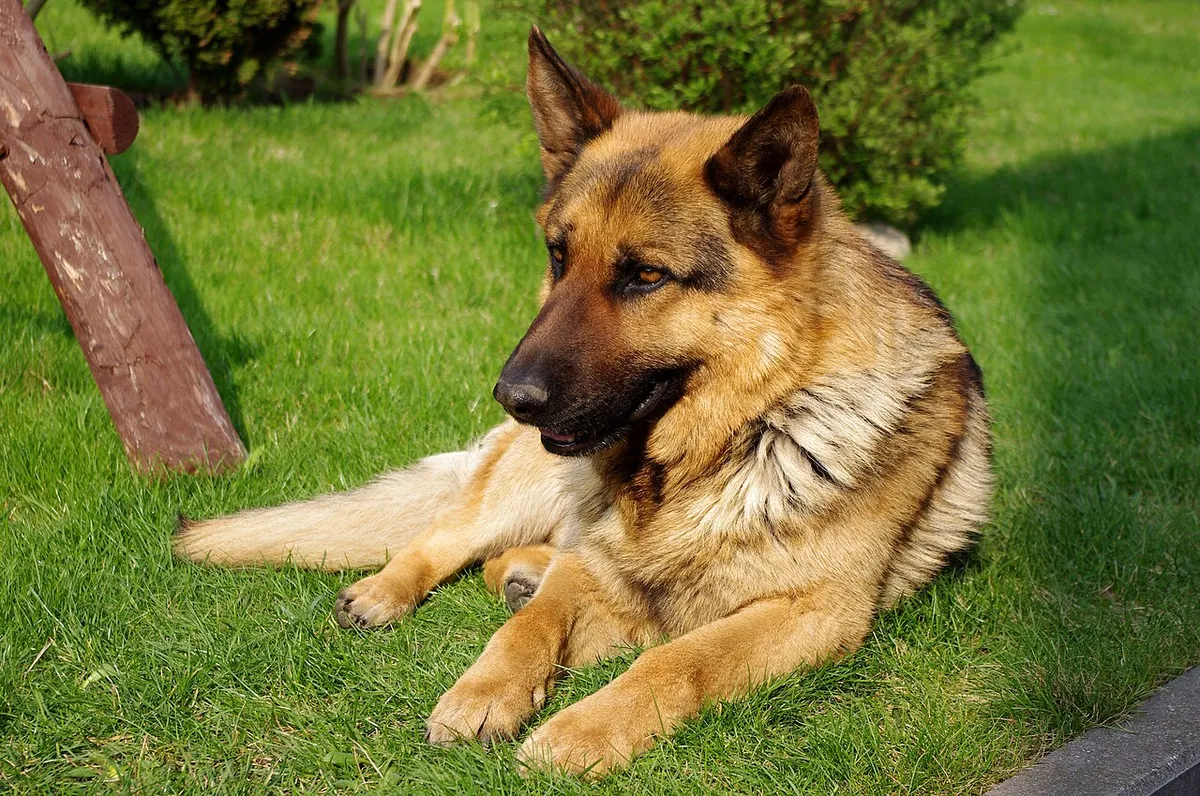
Body Condition Scoring
A weight chart gives you a ballpark, and the puppy growth calculator turns that into a projection for your own dog. Your dog’s body still tells you the real story. Veterinarians use a body condition score (BCS) on a 1-to-9 scale to assess whether a dog is underweight, ideal, or overweight. You can do a simplified version at home:
- Ribs: Run your hands along the ribcage. You should feel individual ribs with light pressure. Visible ribs suggest the dog may be too lean. If you have to press hard, there may be excess weight.
- Waist from above: Looking down, there should be a visible tuck behind the ribcage. A straight or barrel-shaped outline suggests extra weight.
- Belly from the side: The abdomen should tuck upward from the chest toward the hind legs. A sagging or level belly line can indicate the dog is carrying too much.
For Shepherds specifically, a lean body condition through the first two years is generally preferred. Extra weight during growth puts strain on developing joints, and this breed is already among those commonly associated with hip and elbow dysplasia.
When Blaze came to me he was about eight pounds over his ideal weight. It took roughly three months of measured meals and daily walks to bring him back to where he should be. The rib check was how I tracked progress more than the scale.
What If Your Dog Is Above or Below the Chart
A few pounds off the range is rarely a problem on its own. But talk to your vet if:
- Your puppy is consistently more than 15–20% above or below the expected range
- Weight gain has stalled for more than three to four weeks during the rapid-growth window (2–9 months)
- Ribs, hip bones, or spine are prominently visible despite feeding appropriate amounts
- The puppy seems low on energy or has a dull coat alongside being underweight
Your vet can rule out parasites, absorption issues, or other causes and help you adjust feeding if needed. For age-specific portion guidance, see our puppy feeding guide and adult feeding guide. If your dog is consistently above range, our overweight feeding guide covers how to bring the weight down safely.
When Growth Plates Close and Why It Matters
Growth plates are soft areas of cartilage at the ends of long bones. They’re the reason puppies can grow, and they’re also the most vulnerable part of a young dog’s skeleton. In German Shepherds, most growth plates close between 12 and 18 months, though some of the larger joints may not fully harden until closer to 24 months. The only way to confirm closure is through X-rays.
Until those plates close, high-impact activities carry more risk than they would for an adult dog. Hard jumping, forced running on pavement, and repetitive high-intensity exercise can damage growth plates in ways that affect bone development permanently. Moderate play, leash walks, and swimming are safer alternatives during this window. Our exercise needs by age breaks down what is appropriate month by month, which matters most during the adolescent stretch when the dog has the energy for far more than its joints can safely take.
This is also why large-breed puppy formulas control calcium and phosphorus levels. Too-rapid growth doesn’t just mean excess weight. It means bones that develop faster than the supporting structures can handle, which is one of the contributing factors to hip and elbow dysplasia in the breed.
Weight Chart Questions Owners Ask Most
How much should a 6-month-old German Shepherd weigh? At six months, a male typically weighs 49–57 pounds and a female 44–49 pounds. These ranges shift depending on whether the dog comes from working or show lines and how much they’re being fed.
At what age is a German Shepherd fully grown? Full height usually arrives by 12–18 months. Muscle and mass keep filling in after that. Males may not reach their final weight until around two to two-and-a-half years. Females generally finish between 18 and 24 months.
Is my Shepherd puppy too skinny? If ribs, hip bones, or vertebrae are prominently visible, the puppy may be underweight. But Shepherd puppies often look leaner than owners expect, especially between four and eight months when they’re shooting up in height before filling out. A body condition check is more reliable than the scale alone. If you’re concerned, your vet can assess whether the weight fits your dog’s frame and age.
Do male and female German Shepherds weigh the same? No. Males are consistently larger, weighing 65–90 pounds as adults compared to 50–70 pounds for females per the AKC standard. Males also stand about two inches taller on average. The size gap is usually noticeable by three to four months.
Should I weigh my Shepherd puppy regularly? Weekly weigh-ins during the first year help you spot trends early. Many vet offices let you use their scale for free. After 12 months, monthly check-ins are usually enough unless you’re actively adjusting portions.
For a broader look at all our feeding resources, start at the guide to feeding German Shepherds. If you’re budgeting for food through these growth stages, see our monthly food cost breakdown.
Sources
Breed-standard sizing and growth-window guidance on this page are sourced as follows. Last verified 2026-05-21.
- American Kennel Club. German Shepherd Dog Breed Standard. akc.org. Adult-size ranges + breed standard quote box.
- Oberbauer AM, Keller GG, Famula TR. Long-term genetic selection reduced prevalence of hip and elbow dysplasia in 60 dog breeds. PLOS ONE 2017;12(2):e0172918. PMC5325577. Hip/elbow dysplasia framing for lean-growth recommendation.
- World Small Animal Veterinary Association. Global Nutrition Guidelines / Body Condition Score. wsava.org. 9-point BCS reference.
- Merck Veterinary Manual. Feeding Practices in Small Animals: Large-Breed Puppy Diets. merckvetmanual.com. Calcium/phosphorus control for large-breed puppies.
- National Research Council. Nutrient Requirements of Dogs and Cats (2006). National Academies Press. Energy and growth rate references underpinning the stage table.
- Orthopedic Foundation for Animals. Hip Dysplasia. ofa.org. Growth-plate / orthopedic background.
Owner-experience anchors on this page are bounded to Sam’s current dog Blaze (eight-pound overweight intake and measured-meal recovery period).
Disclaimer: This content is for general informational purposes only and is not veterinary advice. Consult a licensed veterinarian for decisions about your dog's health, diet, or medical care. Read full disclaimer →
Follow new work
A new guide every week or so.
Roughly one new guide every week or so. Cost data, feeding research, breed health — sourced and dated. By Sam, in Belgium.
Related Articles
Best Food for a German Shepherd with Slow Growth
Calorie-dense food for slow-growing German Shepherd puppies. When slow growth is normal, when it's not, and what to feed without triggering joint problems.
Best Food for Overweight German Shepherds
How to help an overweight German Shepherd lose weight safely. Body condition scoring, calorie reduction, and what to look for in a weight management food.
How Much to Feed an Adult German Shepherd
How much to feed an adult German Shepherd per day by weight and activity level. Calorie math, body condition scoring, bloat prevention, and meal portions.
How Much to Feed a German Shepherd Puppy
German Shepherd puppy feeding amounts by age, from 8 weeks to 12 months. Cups per day, calorie targets by weight, meal frequency, and body condition tips.

When to Switch German Shepherd from Puppy to Adult Food
Learn when to switch your German Shepherd puppy to adult food. Includes readiness signs, a step-by-step transition schedule, and timing mistakes to avoid.