Best German Shepherd Food
Most adult German Shepherds eat between 2.5 and 4 cups of dry food per day, split across two meals. The exact amount depends on weight, activity level, age, and the calorie density of whatever kibble you’re using.
That last part trips up a lot of owners. A cup of one brand can pack 30% more calories than a cup of another, which means “3 cups a day” means very different things depending on the bag.
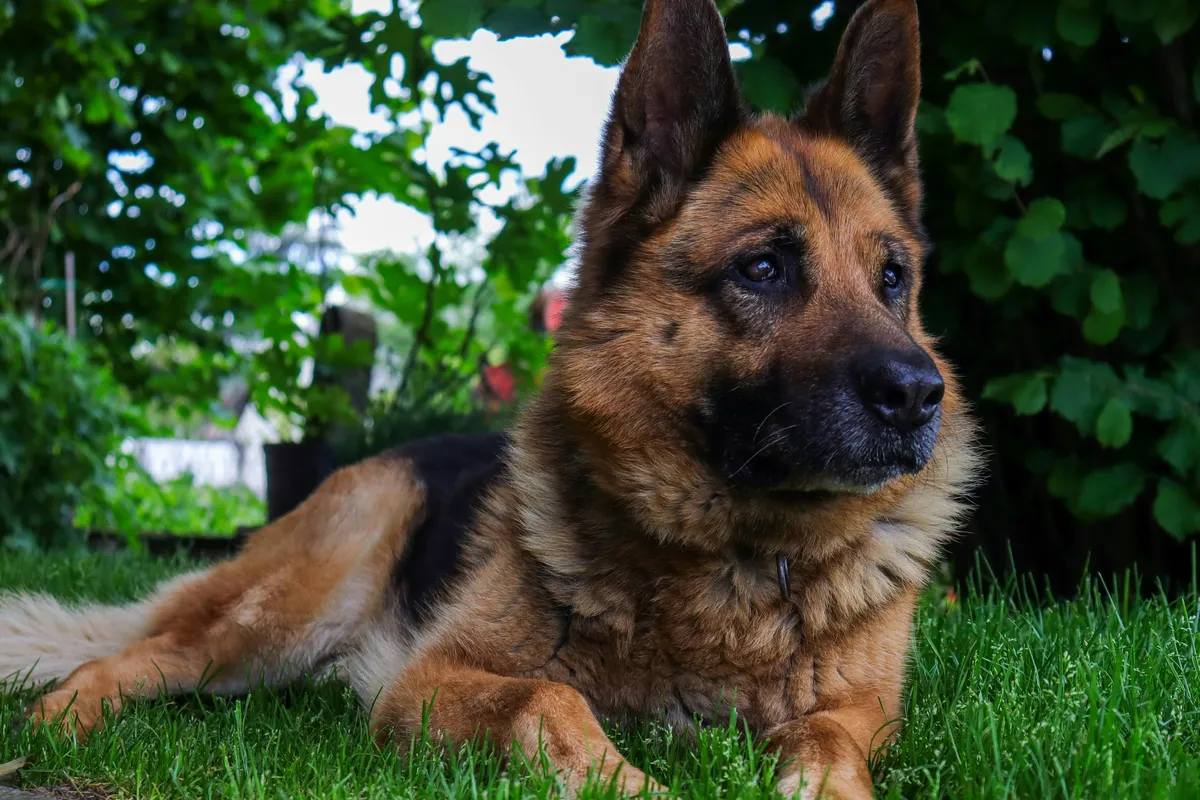
Cups Per Day by Life Stage and Weight
These ranges assume a mid-calorie kibble (roughly 350–400 kcal per cup). If your food is significantly higher or lower, adjust accordingly, or put your dog’s weight and the bag’s kcal/cup into the feeding calculator and let it do the conversion.
| Life Stage | Weight | Cups Per Day |
|---|---|---|
| Puppy (8–12 weeks) | 10–20 lbs | 1 to 1.5 |
| Puppy (3–6 months) | 20–45 lbs | 1.5 to 2.5 |
| Puppy (6–12 months) | 45–70 lbs | 2.5 to 3.5 |
| Adult (1–7 years) | 50–70 lbs | 2.5 to 3.5 |
| Adult (1–7 years) | 70–90 lbs | 3 to 4 |
| Senior (7+ years) | 50–80 lbs | 2 to 3 |
Split the daily total across two meals for adults and seniors. Puppies under six months do better with three meals spread through the day. For a full age-by-age breakdown, see our German Shepherd feeding schedule.
These are starting points. Your Shepherd’s body condition tells you whether to go up or down.
Why Calorie Density Matters More Than Cups
You’ll find wildly different feeding recommendations online. Most of the confusion traces back to one thing: not all kibble delivers the same calories per cup.
| Brand Example | Approx. kcal/Cup | Cups for 1,200 kcal |
|---|---|---|
| Royal Canin GSD Adult | ~321 | 3.7 |
| Purina Pro Plan Large Breed | ~375 | 3.2 |
| Taste of the Wild High Prairie | ~370 | 3.2 |
| Orijen Original | ~463 | 2.6 |
A Shepherd eating three cups of Orijen gets nearly the same energy as one eating 3.7 cups of Royal Canin. So when someone says their dog eats four cups a day and yours only eats three, neither of you is necessarily wrong, you’re just feeding different brands. The brand determines the volume.
Always check the kcal per cup listed on your bag and use that as the real measuring stick. The AKC’s feeding guide recommends the same approach: calories first, cups second.
“The number of calories a dog needs depends on their life stage, lifestyle, and body condition. A simple cup measurement doesn’t account for the vast differences in calorie density between brands.”
— Tufts University, Petfoodology (2024)
For a deeper breakdown across popular brands, see our guide to feeding an adult German Shepherd.
How Activity Level Changes Cup Amounts
The table above assumes a moderately active Shepherd. Not every dog fits that profile. A working dog covering miles of terrain daily burns considerably more than a Shepherd who gets two leash walks and some backyard time.
High-activity dogs (sport, protection training, daily off-leash running): add 15–25% to the baseline. For a dog eating 3 cups, that means 3.5 to 3.75 cups.
Low-activity or recovering dogs (post-surgery, senior, limited mobility): reduce by 10–20%. A 3-cup baseline drops to about 2.5 cups.
Spayed or neutered dogs often need 10–15% fewer calories than intact dogs of the same weight. This catches a lot of owners off guard. The metabolism shift is real, and sticking with pre-surgery portions can lead to gradual weight gain. If you’re seeing extra padding around the ribs, our overweight Shepherd feeding guide has specific strategies.
How to Measure Portions Accurately
Eyeballing portions doesn’t cut it. Research cited by Tufts Petfoodology has shown that owners who scoop kibble without a measuring cup tend to overfeed by 20% or more. Over weeks and months, that adds up fast.
Use a standard 8-ounce dry measuring cup and level it off. A heaped cup holds 15–20% more than a flat one, which over time adds the equivalent of a small extra meal each day. A kitchen scale is even better. I weigh Blaze’s food in grams every meal — it takes five seconds and removes the variability that comes with different kibble shapes settling differently in the cup.
How Many Cups Are in a 30-Pound Bag of Kibble?
Roughly 105 to 135 cups, and the spread is the whole point. A level 8-ounce cup of dry food weighs somewhere between 3.5 and 4.5 ounces depending on how dense the kibble is and how the pieces settle. Divide the 480 ounces in a 30-pound bag by that weight and you land anywhere in that range. Dense, small-piece performance kibble sits at the low end. Large, airy pieces sit at the high end.
For an adult Shepherd eating 3.5 cups a day, that means a 30-pound bag lasts about a month, give or take four or five days. Weigh the food instead of scooping it and you can plan far more precisely: note the grams per meal, multiply by 60 meals, and you know exactly when to reorder. The cost side of that arithmetic is in our monthly food cost breakdown, and the feeding calculator will give you the daily figure to start from.
When Cups Don’t Apply: Wet Food and Toppers
Cup measurements only work for dry kibble. If you mix in wet food or fresh toppers, you need to account for the extra calories and reduce the kibble portion accordingly.
A typical 13-ounce can of wet food runs 350–500 calories. Adding half a can on top of a full kibble serving can push daily intake well past what your dog needs. The simple rule: for every 100 calories of wet food or toppers you add, remove roughly a quarter cup of kibble (assuming a 350–400 kcal/cup kibble).
Treats count too. The WSAVA global nutrition guidelines recommend keeping treats under 10% of total daily calories. For a Shepherd eating 1,200 calories a day, that means no more than 120 calories from treats. Three or four large biscuits can hit that limit.
“Treats should comprise no more than 10% of a pet’s daily caloric intake. Owners should be advised to account for treats when calculating total daily energy requirements.”
Body Condition Scoring Beats Any Chart
The table gives you a baseline. Your dog’s body gives you the answer.
Run your hands along your Shepherd’s ribs every couple of weeks. You should feel them easily under a thin layer of padding. If you can’t find them, cut back. If they’re sharp and obvious, increase portions. The WSAVA body condition scoring guidelines use a 1-to-9 scale and are simple enough to do at home. Our German Shepherd weight chart gives you target ranges by age to cross-reference.
Puppy portions deserve extra attention. Growing Shepherds sit in a narrow window between too little and too much. Underfeeding slows development. Overfeeding can push growth beyond what joints are ready to handle. Our full article on how much to feed a Shepherd puppy covers each stage in detail.
Common Questions About German Shepherd Portions
Should I feed my German Shepherd once or twice a day? Twice. Splitting meals into morning and evening reduces the risk of bloat (gastric dilatation-volvulus), which this breed is predisposed to. The American College of Veterinary Surgeons lists feeding multiple smaller meals as a key prevention strategy. It also keeps energy levels steadier. Some owners of very active Shepherds add a small midday meal during heavy training periods.
Do males eat more than females? Generally, yes. Males average 65–90 pounds and typically need 3 to 4 cups per day. Females average 50–70 pounds and usually fall in the 2.5 to 3.5 range. Body condition and activity level matter more than sex alone.
Should I follow the feeding guide on the bag? Use it as a starting point. Bag guidelines are based on averages and tend to run slightly high. Start at the lower end of the suggested range and adjust based on your dog’s weight and body condition over the following weeks.
My Shepherd always seems hungry. Should I feed more? Not necessarily. Shepherds are food-motivated dogs and many will act hungry no matter what. If your dog is at a healthy weight and body condition, the portions are probably fine. Persistent hunger combined with weight loss warrants a vet check to rule out issues like parasites or malabsorption.
For a complete look at food options, head to our food guide for the breed. If your Shepherd is in the seven-plus range, our senior feeding guide covers the specific adjustments older dogs need. And if you’re curious what all this food costs over time, our monthly feeding cost breakdown has the numbers.
Disclaimer: This content is for general informational purposes only and is not veterinary advice. Consult a licensed veterinarian for decisions about your dog's health, diet, or medical care. Read full disclaimer →
Follow new work
A new guide every week or so.
Roughly one new guide every week or so. Cost data, feeding research, breed health — sourced and dated. By Sam, in Belgium.
Related Articles
German Shepherd Feeding Schedule by Age
A complete German Shepherd feeding schedule from 8-week-old puppy to senior. Meal frequency, portion sizes by age, and sample daily routines that work.

German Shepherd Weight Chart: Puppy to Adult
Month-by-month weight and height ranges for male and female German Shepherds. AKC standard sizes, growth timeline, body condition scoring tips.

How Much Does Feeding a German Shepherd Cost
Monthly feeding costs for German Shepherds broken down by food type, life stage, and extras. Kibble, raw, and fresh options compared with real prices.
How Much to Feed an Adult German Shepherd
How much to feed an adult German Shepherd per day by weight and activity level. Calorie math, body condition scoring, bloat prevention, and meal portions.
How Much to Feed a German Shepherd Puppy
German Shepherd puppy feeding amounts by age, from 8 weeks to 12 months. Cups per day, calorie targets by weight, meal frequency, and body condition tips.