German Shepherd Breed Guide
You come home to find a couch cushion disemboweled. Stuffing across the living room. One shoe destroyed, the other untouched. The door trim has teeth marks. Your Shepherd greets you like nothing happened, tail wagging, apparently thrilled to show you the remodeling.
Destructive chewing is one of the top reasons dogs end up surrendered to shelters. It’s expensive, frustrating, and feels personal. It’s not. Your dog isn’t punishing you for leaving. Something else is going on, and identifying the cause changes everything about how you handle it.
Why Shepherds Chew
All dogs chew. Shepherds chew more intensely because they have powerful jaws, high energy, and active minds that need occupation. But “chewing” is too broad a category. The cause determines the solution.
Teething (puppies under 6 months)
Puppies chew because their gums hurt. Between 12 and 28 weeks, baby teeth fall out and adult teeth push through. The pressure from chewing provides relief. Shepherd puppies have strong jaws even at this age, so the damage potential is real even from a small dog.
Teething-related chewing peaks around 4–5 months and typically resolves by 7 months when the full set of 42 adult teeth is in.
Boredom (adolescents and adults)
This is the most common cause of destructive chewing in Shepherds over 6 months. The breed needs 60–120 minutes of daily physical exercise plus mental stimulation. A dog that gets a 15-minute walk and then spends 8 hours alone with nothing to do will find a project. Your furniture is the project.
Boredom chewing has a pattern. It happens when the dog is alone or understimulated. The items targeted are varied and random. The dog isn’t stressed. It’s just unoccupied.
Anxiety (any age)
Anxiety-driven chewing looks different. The targets tend to be exit points (doors, windows, crates) or items that smell like you (shoes, clothing, couch cushions where you sit). The chewing occurs when you leave and may be accompanied by other signs: barking, pacing, house soiling. There’s frequent overlap with noise phobia (chewing spikes during storms or fireworks) and general fearfulness.
If your dog only chews destructively when left alone and shows other signs of distress, the cause is anxiety, not boredom. The ASPCA guide on destructive chewing calls this distinction the critical first step in addressing the behavior.
How to Tell Boredom from Anxiety Chewing
If you can’t tell, set up a camera (Wyze, a phone propped up, anything). 15 minutes of footage from right after you leave usually tells the whole story.
Boredom vs anxiety — what the chewing pattern tells you
| Signal | Boredom chewing | Anxiety chewing |
|---|---|---|
| Onset | Begins gradually after dog gets bored, often 1–2 hr in | Begins within first 15–30 min of departure |
| Targets | Random — pillow, shoe, remote, whatever’s there | Exit points (doors, crates, windows) or owner-scented items |
| Other signs | Sleeps between bouts; relaxed when you return | Pacing, panting, drooling, vocalization, house soiling |
| Body language on return | Happy/curious/oblivious | Stressed, clingy, or hiding |
| Pattern when stimulated | Resolves with exercise + enrichment | Persists even with adequate exercise |
| Right fix | More exercise, better toys, structured enrichment | Behavior modification, sometimes medication, DACVB if severe |
The Adolescent Destruction Zone
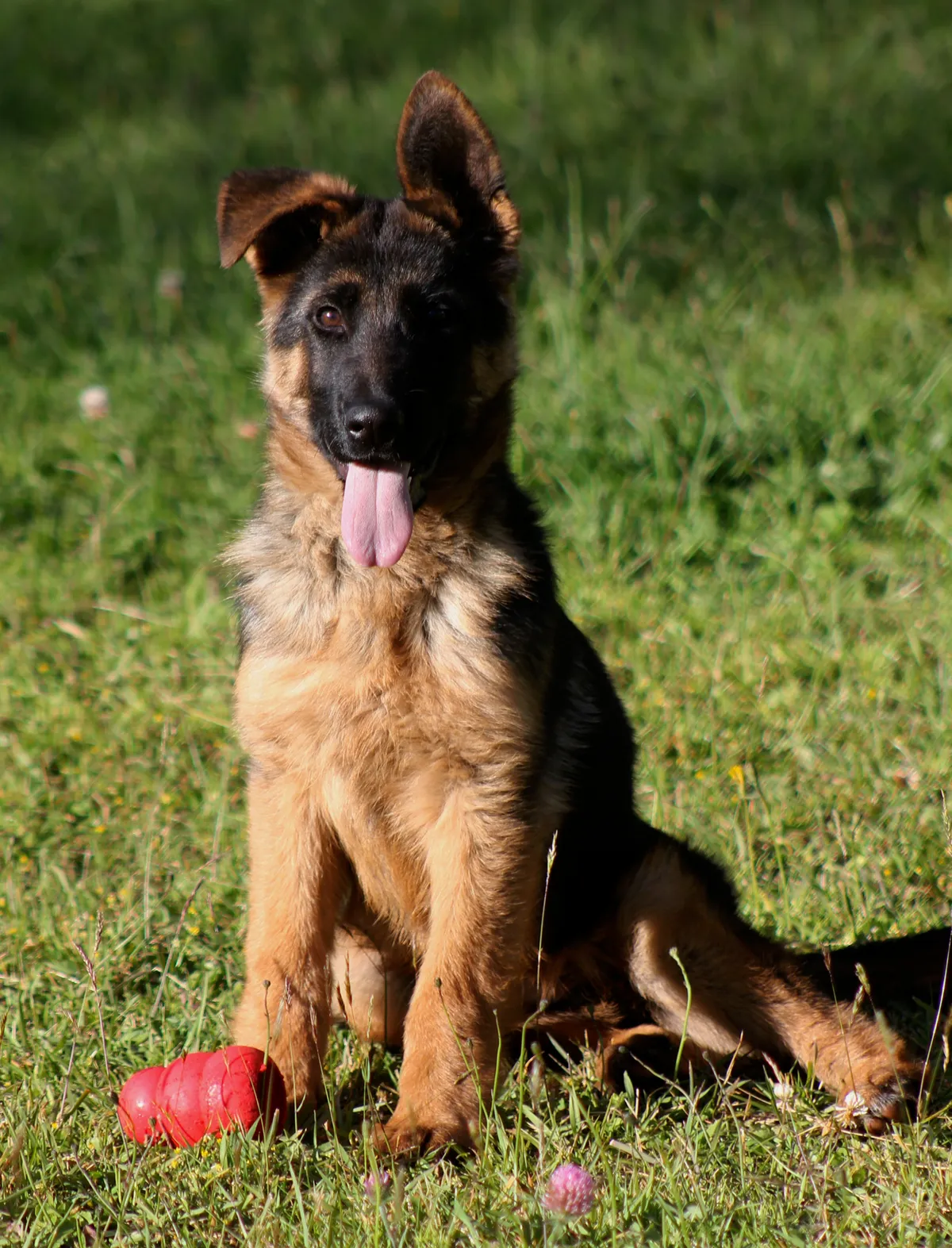
The 6-to-18-month window is when most owners experience peak destruction. The puppy has adult-sized jaws, teenage energy, limited impulse control, and a brain that’s still developing.
Adolescent Shepherds are physically capable of serious damage. They can chew through drywall, destroy crates, and reduce a leather couch to scrap in under an hour. This is not a defective dog. This is a high-energy working breed going through the equivalent of human puberty with no outlet for the intensity.
“Destructive behavior in adolescent dogs is commonly a sign of insufficient mental and physical stimulation rather than a behavioral disorder. Increasing exercise, enrichment, and structured activities resolves the majority of cases.”
— American Veterinary Society of Animal Behavior, Position Statements
What Works
Exercise — the single best prevention
A tired dog doesn’t chew your belongings because a tired dog sleeps. This isn’t oversimplified advice. It’s the foundation.
Before you leave the house, give your Shepherd a solid exercise session. A 30–45 minute brisk walk, a game of fetch, or a structured training session. Combine physical exercise with mental work (obedience drills, scent games, puzzle solving) for maximum effect.
The breed was built to work all day. A walk around the block doesn’t come close to meeting that need. If your schedule doesn’t allow for adequate exercise, a dog walker or daycare may be worth the investment. The math is usually straightforward — see the German Shepherd cost guide for the typical ranges. A $400/month walker is cheaper than a $1,200 reupholstery bill and a $2,500 slab-fracture extraction.
Appropriate chew toys — the safety table
Dogs need to chew. The goal isn’t to eliminate chewing. It’s to redirect it to appropriate items — and to avoid the items that send Shepherds to the dental surgeon.
Chew-toy safety — what veterinary dentists recommend
| Chew item | Power-chewer Shepherd safety | Risk profile | Notes |
|---|---|---|---|
| Frozen stuffed Kong (Black/Extreme) | Safe | Low — soft rubber, can’t fracture teeth | Best long-occupy option. Stuff with peanut butter or wet food, freeze. 20–40 min of engagement. |
| Bully sticks | Generally safe | Choking hazard with the final 2-inch nub — supervise + remove | High-value, long-lasting, single-ingredient. Pick thicker sticks for power chewers. |
| Hard rubber chews (West Paw Hurley, Goughnuts) | Safe | Low | Made for power chewers; passes thumbnail test for give |
| Nylabone Power Chew | Mostly safe | Small pieces can chip off — inspect regularly, replace when worn | Avoid ‘edible’ nylabones for heavy chewers |
| Antlers (deer, elk) | AVOID | High — slab fracture of carnassial tooth | Veterinary dentists actively recommend against. Repair $1.5K–$3.5K. |
| Bones (cooked or raw) | AVOID | Tooth fracture, splintering, GI obstruction | Cooked bones especially dangerous. Even raw bones fracture carnassial teeth. |
| Hooves | AVOID | Tooth fracture, sharp shards | Same risk profile as antlers |
| Rawhide | Use cautiously | Choking + GI obstruction risk with swallowed chunks | Better-supervised options exist. If using, choose US-made and supervise. |
| Tennis balls (as chew, not fetch) | Avoid | Abrasive felt grinds teeth down over time | Fine for fetch, not for chewing |
The simplest field test: try to dent the chew item with your thumbnail. If you can’t make a mark, the item is harder than your dog’s tooth enamel, and your dog’s tooth will lose the contest. Antlers, hooves, and large weight-bearing bones all fail this test.
Rotate toys every few days. A toy the dog hasn’t seen in a week becomes interesting again. Shepherds are smart enough to get bored with the same items on permanent display.
Management — set the dog up to succeed
Until the chewing is under control, don’t give the dog unsupervised access to items you value.
Crate when unsupervised. If your dog is crate trained, crating during absences prevents destruction and keeps the dog safe. The crate should be large enough for the dog to stand, turn around, and lie down comfortably. Make sure the crate is a positive space, not a punishment. Do not crate an anxiety-chewing dog — they often injure themselves trying to escape; that’s a DACVB referral, not a kennel solution.
Dog-proof the environment. Shoes in closets. Remotes off coffee tables. Bedroom doors closed. Manage the environment so the dog can’t practice the wrong behavior.
Bitter apple spray. Apply to items the dog repeatedly targets (furniture legs, baseboards). It doesn’t work for every dog, but many Shepherds dislike the taste enough to redirect elsewhere. Reapply regularly.
What NOT to do
Don’t punish after the fact. If you come home to a destroyed pillow, your dog can’t connect your anger to something it did three hours ago. The guilty look you think you see is a stress response to your body language. A frequently cited study in Behavioral Processes (Horowitz 2009) demonstrated that the “guilty look” appears in response to owner scolding regardless of whether the dog actually did anything wrong.
Punishing after the fact doesn’t reduce chewing. It increases anxiety, which can make chewing worse.
Don’t chase the dog when they grab something. A Shepherd that grabs your shoe and runs is initiating a game. Chasing rewards the behavior. Instead, offer a trade (a treat or a preferred toy) and work on the “drop it” command during training sessions — the same trade-up logic in the resource guarding guide applies here.
Don’t rely on punishment alone. Even in-the-moment corrections (a verbal “no” when you catch them chewing something forbidden) only tell the dog what not to do. Pair it with redirection: remove the forbidden item, give the dog an appropriate chew, and praise them for using it.
When Chewing Signals Something Bigger
Pay attention to the pattern.
Boredom chewing is fairly random in target selection, occurs when the dog has nothing else to do, and resolves with increased exercise and enrichment.
Anxiety chewing targets exit points and owner-scented items, occurs specifically during your absence, and is accompanied by other anxiety signs. Behavioral approach required.
Pica (eating non-food items like rocks, fabric, or plastic) is different from chewing and can be dangerous. If your dog regularly ingests non-food items, consult your vet. Can indicate nutritional deficiencies, GI issues, or compulsive behavior.
Sudden onset of destructive chewing in a previously non-destructive adult dog warrants a vet check. Pain, illness, or cognitive changes can trigger new destructive behaviors.
A Realistic Timeline
Puppy teething resolves on its own by 7 months, though the chewing habit may persist if the puppy was never taught what is appropriate to chew.
Adolescent destruction peaks between 8–14 months and typically improves as the dog matures and as exercise and enrichment routines are established. Most owners see significant improvement by 18–24 months.
If destructive chewing persists past 2 years in a dog that gets adequate exercise and enrichment, consult a certified trainer or DACVB. Something else may be driving the behavior — often an undiagnosed anxiety disorder.
Good nutrition supports stable energy and development through the adolescent phase.
For related challenges, see fearfulness, noise phobia, reactive vs aggressive behavior, and resource guarding.
Sources
- ASPCA. Destructive Chewing. aspca.org. Boredom vs anxiety distinction.
- American Veterinary Dental College. Tooth Fracture in Dogs. avdc.org. Slab fracture causes and repair costs.
- Horowitz A. Disambiguating the “guilty look”: Salient prompts to a familiar dog behavior. Behavioral Processes 81(3): 447–452 (2009). sciencedirect.com.
- American Veterinary Society of Animal Behavior. Position Statements. avsab.org.
- American Kennel Club. How to Stop a Dog from Chewing. akc.org.
- Veterinary Oral Health Council. Accepted Products List. vohc.org. VOHC-accepted chews meet standardized safety + efficacy criteria.
- American College of Veterinary Behaviorists. Find a DACVB. dacvb.org.
Follow new work
A new guide every week or so.
Roughly one new guide every week or so. Cost data, feeding research, breed health — sourced and dated. By Sam, in Belgium.
Related Articles

German Shepherd Scared of Everything — Building Confidence
Fearful German Shepherd: socialization window, two fear periods, why flooding backfires, and the 5-step counter-conditioning protocol that works.

German Shepherd Fear of Loud Noises: Thunderstorms and Fireworks
Noise phobia in German Shepherds: the medications vets prescribe (Sileo, trazodone, gabapentin) and a real Fourth-of-July event-day checklist.
Is My German Shepherd Reactive or Aggressive?
Reactive vs aggressive German Shepherd: body-language matrix, the 4-distance recovery test, Dunbar bite scale, and when a DACVB is required.