German Shepherd Breed Guide
Your Shepherd growled at you over a bone. Or stiffened when you walked past while it was eating. Or blocked your partner from sitting next to you on the couch. It is unsettling, especially from a large, powerful dog. But understanding what is happening, and where on the escalation ladder your dog actually sits, is the first step toward fixing it.
Resource guarding is a normal canine behavior. It exists in wolves, in street dogs, and in every breed. The dog is protecting something it values from a perceived threat. That doesn’t mean it’s acceptable in a household, particularly with a dog this strong. But it does mean this is not a broken dog. It’s a dog communicating something, and the communication needs to be taken seriously.
The Donaldson Escalation Ladder
Trainer Jean Donaldson formalized a 6-level framework for thinking about guarding. It matters because where your dog sits on the ladder determines (a) what training will actually work and (b) whether you can do this yourself or need professional help.
Resource-guarding escalation ladder — each step up doubles the urgency; L4+ = professional, not DIY
| Level | What it looks like | What to do |
|---|---|---|
| L1 · Subtle body tension | Eats faster, freezes briefly, hard eye when you walk past | DIY with hand-feeding + approach-bonus protocol |
| L2 · Lip lift / whale eye | Visible teeth, whites of the eyes show, dog goes still | DIY but tighten management; add trading games |
| L3 · Growl | Audible warning | Never punish. CPDT-KA or CDBC consult recommended if recurring |
| L4 · Snap (air bite) | Bite without contact — this is intentional miss | CDBC at minimum, DACVB if the dog has snapped at family |
| L5 · Inhibited bite | Contact with restraint — bruising, shallow puncture | DACVB referral required. Begin liability planning. |
| L6 · Uninhibited bite | Full-force contact, multiple bites possible | DACVB + safety planning; rehoming or BE is on the table. |
Source: J. Donaldson, MINE! A Practical Guide to Resource Guarding (Dogwise) + Dunbar Bite Scale alignment. L = level. “BE” = behavioral euthanasia, the most difficult conversation, sometimes the only ethical one. Knowing where your dog is determines who you call.
The ladder is not deterministic — dogs don’t always climb. Most stay at L1–L3 their entire lives if managed well. The point is to know which level you’re at before you choose an intervention. Reading the reactive vs aggressive guide is also useful here — the body-language matrix overlaps directly with L1–L3 signals.
The AVSAB’s position is that reward-based methods should be the first line of training, and that aversive, punishment-based methods are associated with an increased risk of fear and aggression — the opposite of what a guarding dog needs.
— Position summary, American Veterinary Society of Animal Behavior, Humane Dog Training Position Statement (2021)
Why Shepherds May Be More Prone
Any dog can resource guard, but a few breed traits can amplify it.
Strong bonding. Shepherds attach deeply to their primary person. That attachment can extend to guarding the person as a resource. A dog that growls when another family member approaches “their” person is guarding a social resource — the overprotective guide covers that exact pattern as the visitor-facing version.
Working drive. The breed was developed to work and to take possession of tasks and territory seriously. That intensity can translate to possessiveness over valued objects.
Intelligence and pattern recognition. Smart dogs learn quickly what predicts loss. If the owner always takes the bone away, the dog learns: approaching person equals losing the thing. The guarding escalates because the pattern teaches the dog that their fear is justified.
Confidence. Shepherds are generally bold dogs. A bold dog is more likely to guard actively (growling, lunging) than a timid dog that simply avoids or retreats.
None of this makes the behavior inevitable. Plenty of Shepherds never guard a thing. But when it does occur, the breed’s size and strength make it a priority to address.
What NOT to Do
The biggest mistakes come from outdated “dominance” advice. These reliably make the problem worse.
Don’t take things away to “show who’s boss.” This confirms the dog’s fear. It learns: I was right, people do take my things. Next time, it guards harder and earlier.
Don’t punish the growl. A growl is a warning. Punish the warning and the dog skips it next time, going straight to snapping or biting. You want the dog to communicate discomfort, not suppress it.
Don’t alpha roll or physically intimidate. Dangerous with any dog. With a Shepherd that’s already guarding aggressively, it’s a recipe for a bite — and a legal record that “the owner forced a confrontation.”
Don’t stare the dog down or challenge it. You won’t win a contest of will with a dog defending what it sees as a critical resource. You’ll damage trust.
Veterinary behavior guidance is consistent on this point: confrontational and punishment-based responses to guarding tend to escalate it, increasing the risk of a defensive bite rather than resolving the underlying anxiety.
— Position summary, Merck Veterinary Manual, Behavioral Problems of Dogs
The Three Protocols That Work
All three rest on the same principle: change the dog’s prediction about what humans approaching means. Right now your dog predicts loss. The work is teaching it to predict gain.
Protocol 1 — Hand feeding
Feed a portion of meals piece-by-piece from your hand for 2–4 weeks. The dog learns that your hand near food is the source of food, not a threat. Most effective with puppies; still useful with adults.
Protocol 2 — Trading games
Teach the dog that giving something up results in getting something better.
- Dog has a low-value item (a toy, an empty Kong).
- Approach with a high-value treat (chicken, cheese, freeze-dried liver).
- Say “trade” (or “drop”) — present the treat at the dog’s nose.
- Dog drops the item, gets the treat.
- Give the original item back. This is critical. The trade isn’t a trick; it’s an exchange.
Repeat 5–10 times per session, several times a week. Build up to higher-value items only when the dog is enthusiastic about the trade with lower-value ones.
Protocol 3 — Approach equals bonus
While the dog is eating from its bowl, walk past at a comfortable distance and toss a piece of chicken or cheese into the bowl without stopping. Don’t reach for the bowl. Don’t stand and hover. Just walk by and make the bowl better.
The dog learns: a person approaching my food means more food, not less. Over weeks, gradually decrease the distance. The endgame is being able to walk right up to the bowl and add to it. You will probably never need to actually take the bowl away mid-meal — and you shouldn’t.
What ties them together
All three protocols share the same logic structure:
The three protocols — same principle, three resources
| Protocol | Trigger | What the dog learns | Typical timeline |
|---|---|---|---|
| Hand feeding | Human hand near food | Hand = source of food, not threat | 2–4 weeks for puppies; 4–8 weeks for adults |
| Trade-up | Human asks for an item | Giving up an item = better item + original back | 4–8 weeks for L1–L2; longer for L3 |
| Approach equals bonus | Human walks past while eating | Approach = bonus arrives in bowl | 6–12 weeks; lifelong intermittent reinforcement |
The thread: stop being the predictor of loss. Become the predictor of gain.
Managing Moderate Guarding (L2–L3)
If your dog is at lip-lift or growling but hasn’t snapped or bitten:
- Manage the environment. Remove high-value items that trigger guarding in multi-dog or multi-person households. Feed dogs separately. Put chews away when guests visit.
- Run the approach-equals-bonus protocol with the specific resources the dog guards.
- Never confront. If the dog has a stolen object, trade for it. If the dog is on the couch and growls when asked to move, lure off with a treat rather than physically removing it.
- Consider a certified trainer. A CPDT-KA trainer or IAABC CDBC consultant who uses positive reinforcement can guide a structured plan. The IAABC directory is the right starting point.
When It Is Beyond DIY
Professional help is not optional if:
- The dog has snapped at or bitten anyone (L4+)
- The behavior is escalating — getting worse, spreading to new resources
- There are children in the household
- The dog guards people aggressively (see overprotective)
- Multiple family members are afraid of the dog
A board-certified veterinary behaviorist (DACVB) is the standard for aggression cases. They can assess whether medication (fluoxetine, clomipramine, situational trazodone) would help alongside behavior modification. Some dogs have underlying anxiety that amplifies guarding, and a baseline lowered by medication is sometimes the only way the training takes hold.
A certified applied animal behaviorist (CAAB / ACAAB) is another excellent option, and our training cost guide covers what each tier of professional charges. Avoid trainers who rely on punishment, prong collars, or dominance theory for guarding cases. These methods carry a high risk of escalation with a dog already in conflict — and a documented professional-aversive incident is not something you want in your liability record if the dog later bites a visitor.
Resource Guarding in Multi-Dog Households
If you have multiple dogs and one guards from the other, management is essential. Inter-dog guarding is one of the most common triggers for serious household fights, and bite injuries between two large Shepherds can require emergency vet care that runs into thousands.
Feed separately. Different rooms, or at minimum different sides of the room with visual barriers. A slow feeder also stretches mealtime out, which lowers the race-to-finish tension. Pick up bowls when mealtime is over. Don’t free-feed in a multi-dog home with a guarder.
Provide individual resources. Each dog gets its own bed, water station, and set of toys. Scarcity — real or perceived — drives guarding. When every dog has its own things, competition decreases.
Manage high-value items. Bones, bully sticks, stuffed Kongs: give these in separate, enclosed spaces (different rooms, crates). If the dog is destroying them fast, our chewing guide covers what holds up. Don’t leave them lying around for dogs to compete over.
Consistent rules. Ask for a sit before meals, treats, attention, and doorways. This reduces arousal around transitions, which is when most guarding incidents happen.
If the guarding involves serious aggression between dogs — injuries, sustained fights, one dog unable to relax around the other — professional help is not optional. The same DACVB and IAABC recommendations apply.
Realistic Timelines
Mild guarding (L1–L2): Often resolves within 2–4 weeks of consistent approach-equals-bonus protocol and trading games.
Moderate guarding (L3): Improvement typically takes 4–8 weeks. The dog may always need some management in high-value situations, but intensity and frequency decrease with consistent work.
Serious guarding (L4–L6): Requires professional guidance. With medication and behavior modification, most dogs show improvement in 2–3 months, but lifelong management is typical. A small subset of L5–L6 dogs cannot safely live in homes with children or frequent visitors — that conversation is the hardest one a behaviorist has, and it should not be avoided.
For related challenges, see aggression, reactive vs aggressive, overprotective behavior, and fearful behavior. Guarding that first appears between six and eighteen months often overlaps with the adolescent phase.
Sources
- Donaldson J. MINE! A Practical Guide to Resource Guarding in Dogs. Dogwise, 2002. Origin of the escalation framework.
- Dunbar I. Dunbar Bite Scale. dogstardaily.com. Calibrates L4–L6 contact severity.
- Jacobs JA, Coe JB, Pearl DL, Widowski TM, Niel L. Factors associated with canine resource guarding behavior in the presence of people: A cross-sectional survey of dog owners. Preventive Veterinary Medicine 2018;161:143–153. ScienceDirect. Source of the prevalence figures (3,589 dogs; ~54% any guarding; 6.81% aggressive guarding toward people).
- AVSAB. Humane Dog Training Position Statement (2021). PDF.
- AVSAB. Position Statement on the Use of Dominance Theory in Behavior Modification of Animals. avsab.org.
- Merck Veterinary Manual. Behavioral Problems of Dogs. merckvetmanual.com.
- American College of Veterinary Behaviorists. Find a DACVB. dacvb.org.
- International Association of Animal Behavior Consultants. iaabc.org.
Follow new work
A new guide every week or so.
Roughly one new guide every week or so. Cost data, feeding research, breed health — sourced and dated. By Sam, in Belgium.
Related Articles
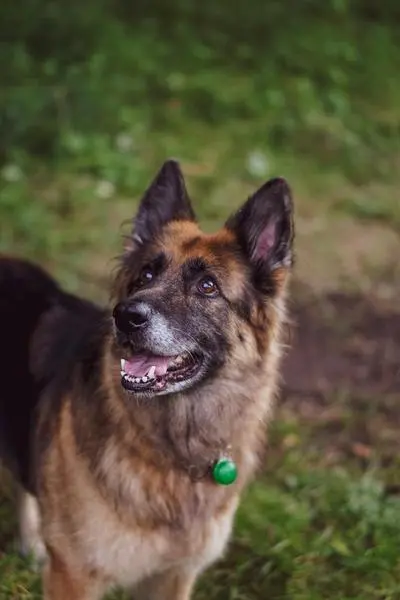
German Shepherd Aggression: Why It Happens and What to Do
German Shepherd aggression: fear vs reactivity, the dominance myth debunked, O'Neill 2017 data, $69K liability reality, when only a DACVB will do.
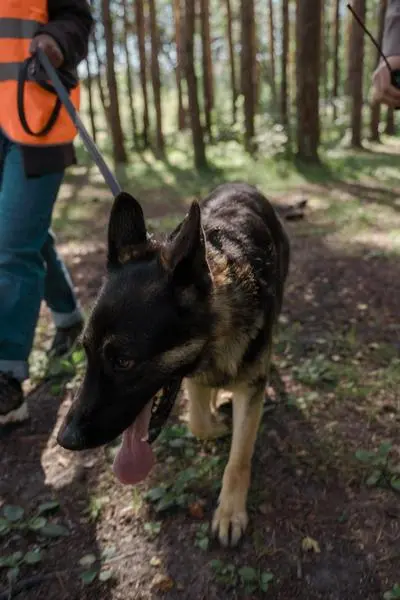
German Shepherd Overprotective of Owner — What to Do
Overprotective German Shepherd behavior explained: the resource-guarding reality, nerve strength in working lines, and a 5-phase visitor protocol that works.
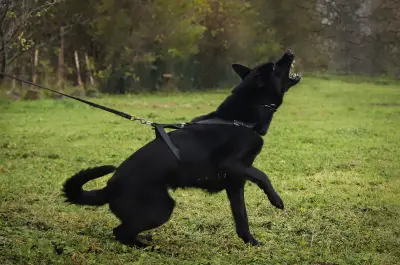
Is My German Shepherd Reactive or Aggressive?
Reactive vs aggressive German Shepherd: body-language matrix, the 4-distance recovery test, Dunbar bite scale, and when a DACVB is required.