German Shepherd Breed Guide
Your friend walks through the front door and your Shepherd loses it. Barking, lunging, positioning between you and the visitor like an 80-pound security detail nobody hired. You grab the collar, drag the dog to another room, and spend the rest of the evening apologizing.
This is one of the most common behavior complaints from Shepherd owners. The dog that seemed loyal and attentive at 6 months has become a liability at 2 years. You can’t have people over without a management plan. Repair workers, delivery drivers, even family members who visit infrequently can trigger a response that ranges from intimidating to genuinely dangerous.
The behavior is manageable. But you have to understand what’s actually driving it before the training makes sense.
Why Shepherds Do This More Than Other Breeds
The AKC breed standard calls for a dog that is “watchful,” “alert,” and “willing to serve.” Those traits made the breed exceptional for police, military, and protection work. They also mean the average pet Shepherd comes pre-loaded with a guarding instinct that most owners never asked for and don’t know how to manage.
Three things make Shepherds particularly prone to overprotective behavior:
Handler attachment. The breed bonds intensely to one or two people. That loyalty is one of the reasons people love Shepherds. It also means some dogs begin treating their person as a resource to guard — no different in principle from food or territory. Behaviorists call this owner-as-resource guarding. The resource-guarding guide covers the underlying pattern; this article covers the visitor-facing version.
Threat assessment on a hair trigger. Shepherds have a low threshold for environmental stimuli. A sound, a movement, a stranger’s body language that a Golden Retriever would ignore will put a Shepherd on alert. When that alert happens near their person, the dog interprets it as a threat to the resource they value most.
Genetic selection for suspicion. Working-line Shepherds were bred to be skeptical of strangers. That wariness served the breed’s original purpose. In a living room with dinner guests, it creates conflict.
”Protective” vs Actually Protective
This distinction matters because most owners get it wrong, and the wrong frame leads to the wrong training plan.
A genuinely protection-trained dog (Schutzhund / IPO / IGP-titled, or police K9) responds to real threats with controlled, proportional behavior, holds position, and waits for a command. The behavior is calm, deliberate, and cued by the handler. Reputable working-line breeders evaluate this trait under the term “nerve strength” — and they explicitly select against the door-charging, visitor-lunging pattern pet owners romanticize. A dog that loses composure at every doorbell is reading as having weak nerves, not strong protective instinct.
An overprotective pet dog reacts to ordinary, non-threatening situations with disproportionate intensity. The mailman. Your mother-in-law. A child running past on the sidewalk. The dog is not reading a real threat. It is responding to anxiety, insecurity, or possessiveness that has been reinforced through repetition.
What “overprotective” actually is — four patterns, four different fixes
| Pattern | What it looks like | Tell that distinguishes it | First step |
|---|---|---|---|
| Owner-as-resource guarding | Dog growls when someone approaches you specifically; blocks/positions between you and others; calm in your absence | Behavior is about you. Calm and friendly with the same people if you’re not there | Resource-guarding protocol on the owner: trade-ups, neutral handler cues, distance work |
| Territorial aggression | Door-charging, fence-line lunging, window barking; usually stops at the property line | Behavior is about the boundary, not the person. Often friendly to visitors once they’re inside | Threshold management: baby gate before door opens; place command before doorbell |
| Fear-based stranger aggression | Stiff posture, hard eye, lip lift; visitor enters and dog escalates the longer they stay | Body language is conflicted (weight back) not committed (weight forward) | Counter-conditioning at sub-threshold distance; never flood |
| Barrier frustration | Massive reaction through fence/window/leash; often friendly once barrier is removed | Off-leash, off-property, dog is fine with the same trigger | Reduce barrier exposure during retraining; structured greetings without the barrier |
“Dogs that exhibit territorial aggression are often insecure and lack the confidence to handle the situation. The aggressive display is an attempt to increase distance from a perceived threat.”
— Merck Veterinary Manual, Behavioral Problems of Dogs
If your Shepherd guards you but is relaxed and friendly when you are not present, that is a strong indicator of owner-as-resource guarding, not true protection. The aggression overview covers the rest of the aggression taxonomy if you’re trying to tell which pattern fits.
What Makes It Worse
Several common owner responses accidentally reinforce the problem.
Comforting the dog during a reaction. Petting, soothing words, or holding your dog while it barks at a visitor teaches the dog that the reaction gets your attention and physical closeness. From the dog’s perspective, the behavior worked.
Isolating the dog when visitors arrive. Removing the dog to another room every time someone comes over prevents the dog from ever learning that visitors are normal. The behavior stays frozen at the same intensity because the dog never gets a chance to practice calm behavior around people.
Inconsistent rules. If the dog is allowed to bark at the delivery driver but corrected for barking at your friend, the dog can’t distinguish between acceptable and unacceptable guarding. The rules need to be the same every time.
Physical punishment or yelling. The AVSAB Humane Dog Training Position Statement (2021) is unambiguous: aversive methods cause “inhibition of learning, increased fear-related and aggressive behaviors, and injury.” Punishing a dog for growling removes the warning signal while leaving the underlying motivation intact. The next step after a suppressed growl is a bite without warning.
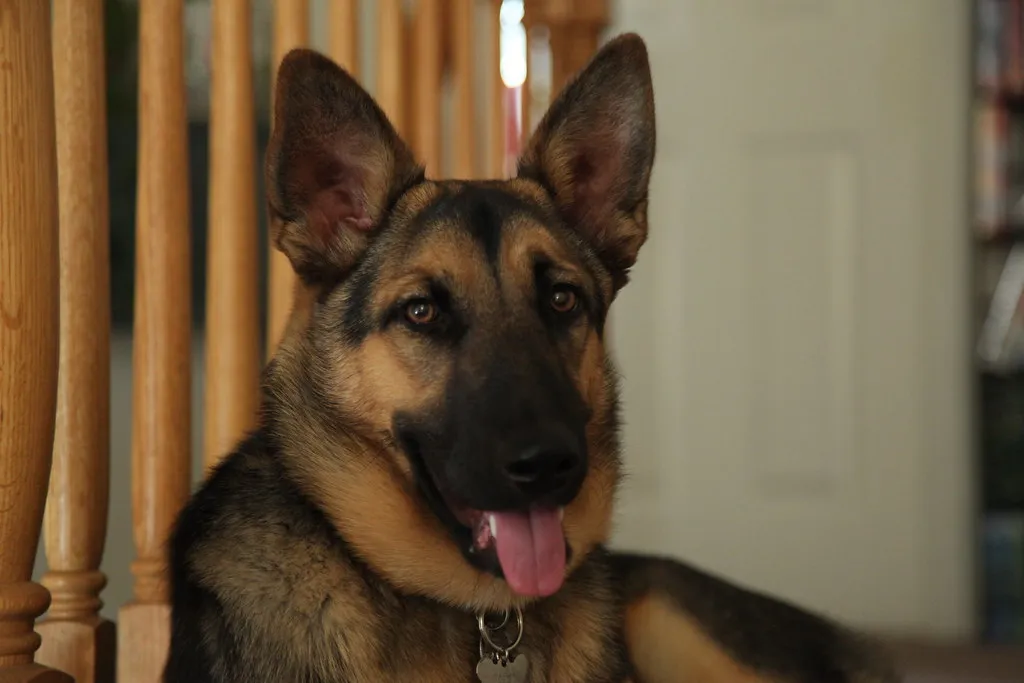
The 5-Phase Desensitization Protocol
This isn’t a quick fix. It requires consistency over weeks and months. But it’s the approach recommended by veterinary behaviorists and backed by the evidence.
Phase 1: Management (weeks 1–2)
Before any training, stop letting the dog practice the behavior. Every time your Shepherd successfully drives a visitor away with barking and lunging, the neural pathway gets stronger.
- Crate or exercise pen with a closed door for visitor arrivals during the management phase. No exceptions.
- Baby gate to create a visual barrier if a crate isn’t realistic. Crate and gate both land in the first-year cost if you are still setting up.
- Don’t try to train and host a visit at the same time. The first two weeks are about preventing rehearsal, not teaching calm.
Phase 2: Threshold Work (weeks 2–6)
Find the distance at which your dog notices a stranger but doesn’t react. That’s your starting line. This is the same logic the leash reactivity guide uses for outdoor triggers, applied indoors.
Recruit a helper (not a stranger to you — the dog doesn’t need a stranger, you need a person to act like one). They stand outside at the determined threshold distance. At the moment your dog notices, you feed treats. They walk away, treats stop. Repeat 5–10 short sessions across days.
Over sessions, decrease distance. If the dog reacts, you moved too fast. Go back to the last distance that worked.
Phase 3: Place Command (weeks 4–8)
Build a 30-minute “place” duration on a designated mat or cot, positioned away from the door. The mat becomes the dog’s job during visitor entries.
Start with 30 seconds on the mat for a treat. Build duration incrementally. Add distractions: you walking around, the doorbell ringing, a visitor outside the door. The place behavior needs to be solid in low-stress conditions before adding visitor pressure.
Phase 4: Doorbell Drill (weeks 6+)
Classical conditioning. Doorbell rings, treats appear from your hand regardless of what the dog does. Run 30–50 reps over a week with no actual visitor before adding one. The doorbell stops predicting threat and starts predicting food.
Combine with the place cue: doorbell rings, you cue place, treats rain. Eventually the doorbell becomes the dog’s cue to head to the mat on its own.
Phase 5: Controlled Visitor Reps
Visitor enters. Ignores the dog completely — no eye contact, no greeting, no reaching to pet. Walks past, sits down, has a normal conversation with you. Dog stays on place. Treats from your hand only.
If the dog holds the down-stay, that’s success. If the dog stiffens, stares, or shows tension, the visitor stays neutral (doesn’t approach, doesn’t reach), and you increase distance or end the rep. Pushing past a threshold at this stage undoes weeks of progress.
Add visitor-tossed treats only once the dog is genuinely neutral about their presence. Never let visitors “make friends” with a reactive Shepherd on day one. That’s how bites happen.
When You Need Professional Help — and Who to Call
If your Shepherd has bitten or attempted to bite a visitor, this is beyond DIY training. A bite history changes the urgency and the liability. The credential hierarchy matters more than most owners realize.
Trainer / behaviorist credentials, matched to severity
| Credential | What it means | Best for |
|---|---|---|
| CPDT-KA | Knowledge-assessed dog trainer; basic operant conditioning, no aggression specialization required | Prevention work in puppies + adolescents with no bite history |
| CDBC (IAABC) | Certified Dog Behavior Consultant; 500+ hours including documented aggression cases | Adult dogs with growling/lunging but no bite history |
| CAAB / ACAAB | Certified Applied Animal Behaviorist; Master’s or PhD in animal behavior | Severe cases, multi-modal protocols, behavior assessment for litigation |
| DACVB | Board-certified veterinary behaviorist; can prescribe psychotropic medication | Any bite history, family-directed aggression, escalating patterns, anything refractory to behavior modification alone |
A DACVB can rule out medical contributors (pain, thyroid, neurological), prescribe medication if needed, and build a comprehensive behavior modification plan. In some cases anti-anxiety medication is not a crutch but a prerequisite — it lowers the dog’s baseline arousal enough for the desensitization to take hold. Think of it as turning down the volume so the dog can actually hear the lesson.
What Realistic Progress Looks Like
You will probably never turn an overprotective Shepherd into a dog that greets strangers with a wagging tail and a toy in its mouth. That’s not a realistic goal for this breed, and pretending otherwise sets you up for frustration.
What you can achieve:
- A dog that looks to you for guidance when someone enters rather than reacting independently
- A dog that can hold a place command while visitors are in the home
- A dog that tolerates known visitors without guarding behavior
- A dog that gives clear, manageable signals (mild alert, checking in with you) instead of explosive reactions
That’s a well-managed Shepherd. Not a dog that’s been trained out of its nature, but a confident dog that trusts your judgment about who belongs in the house.
For related challenges, see German Shepherd aggression, reactive vs aggressive behavior, and resource guarding. If the door-charging is part of a wider noise-anxiety pattern (panic during storms or fireworks), the noise phobia guide covers that overlap.
Sources
Visitor-protocol and liability data on this page are sourced as follows. Last verified 2026-05-22.
- American Veterinary Society of Animal Behavior. Humane Dog Training Position Statement (2021). PDF. Standard-of-care against aversives in aggression cases.
- International Association of Animal Behavior Consultants (IAABC). Resolving Resource Guarding. iaabc.org. Owner-as-resource framing.
- Stewart G. Behavior Adjustment Training 2.0: New Practical Techniques for Fear, Frustration, and Aggression in Dogs. Dogwise, 2016. Threshold-distance work referenced in Phase 2.
- Merck Veterinary Manual. Aggression in Dogs. merckvetmanual.com. Territorial-aggression-as-insecurity framing.
- American Kennel Club. German Shepherd Dog breed standard. akc.org. “Direct and fearless, but not hostile” — the standard the breed is judged against.
- American College of Veterinary Behaviorists. Find a Veterinary Behaviorist (DACVB). dacvb.org. The only credential that can both diagnose behavioral disorders and prescribe medication.
- Certification Council for Professional Dog Trainers. CPDT-KA Directory. ccpdt.org.
- Insurance Information Institute. Spotlight on Dog Bite Liability. iii.org. 2024 average claim $65,450; total claims $1.86B.
- Animal Legal & Historical Center, Michigan State University. Table of State Dog Bite Laws. animallaw.info. Strict-liability vs one-bite-rule state-by-state breakdown.
Follow new work
A new guide every week or so.
Roughly one new guide every week or so. Cost data, feeding research, breed health — sourced and dated. By Sam, in Belgium.
Related Articles
German Shepherd Aggression: Why It Happens and What to Do
German Shepherd aggression: fear vs reactivity, the dominance myth debunked, O'Neill 2017 data, $69K liability reality, when only a DACVB will do.
Is My German Shepherd Reactive or Aggressive?
Reactive vs aggressive German Shepherd: body-language matrix, the 4-distance recovery test, Dunbar bite scale, and when a DACVB is required.
German Shepherd Resource Guarding: Food, Toys, and People
Resource guarding in German Shepherds: the 6-level escalation ladder, why punishing the growl backfires, and the protocols that actually work.