German Shepherd Breed Guide
On this page · 12 sections
- 01First: Is It Actually Aggression?
- 02The Breed Is Not Inherently Aggressive
- 03The Dominance Myth
- 04Types of Aggression
- 05Warning Signs Before a Bite
- 06Triage: What to Do First
- 07What You Can Do for Mild Cases
- 08The Liability Reality
- 09When to Get Professional Help
- 10Preventing Aggression
- 11Related Behavior Guides
- 12Sources
Your Shepherd growled at a visitor. Or lunged at another dog on a walk. Or snapped when someone reached for their food bowl. Your stomach dropped, and now you are searching for answers at midnight.
Aggression in a large, powerful breed is frightening. It carries real consequences. A 70-to-90-pound dog that bites can cause serious injury, and the legal and financial fallout can be severe. This is not something to minimize.
But it is not a reason to panic blindly. Most aggressive behavior in Shepherds has identifiable causes, and most of those causes are manageable. The first step is accurate diagnosis.
Source: O'Neill et al. 2017, VetCompass UK primary care (n=14,140)
Male Shepherds had aggression recorded at roughly 2.4 times the rate of females in that cohort. It stays a minority figure in either sex, and this is aggression recorded in vet notes, not a measure of how many dogs are dangerous.
First: Is It Actually Aggression?
Most Shepherds that owners describe as “aggressive” are actually reactive. The difference matters because the treatment is completely different.
Reactive: The dog overreacts to a trigger (another dog, a stranger) and the behavior is about creating distance. The dog wants the scary thing to go away. It recovers quickly once the trigger is removed.
Aggressive: The dog is willing to approach and engage. The behavior is about closing distance, not creating it. The dog does not settle when the trigger leaves.
If your dog lunges and barks on leash but is calm off leash, that is almost certainly reactivity. The fix is desensitization at distance, not an aggression protocol. The dedicated leash reactivity guide walks through the distance-and-rewards protocol step by step.
The Breed Is Not Inherently Aggressive
This myth needs to die. German Shepherds are not inherently aggressive dogs. The perception is fueled by their police and military use, media portrayals, and their imposing size.
The AKC breed standard calls for a dog that is “direct and fearless, but not hostile.” The breed was developed to be confident, alert, and willing to protect when necessary. That is not aggression.
Bite statistics are cited out of context constantly. Large breeds appear more often in bite reports because their bites cause more damage and are more likely to require medical attention. A Chihuahua bite rarely makes it into a hospital record.
“Controlled studies have not identified this breed group as disproportionately dangerous. The AVMA recommends against breed-specific legislation and emphasizes that behavior is influenced by multiple factors including genetics, socialization, training, and individual temperament.”
— American Veterinary Medical Association, Dog Bite Risk and Prevention
The Dominance Myth
If someone tells you your Shepherd is aggressive because it is “trying to be dominant” or “challenging your alpha status,” walk away. This advice is decades out of date and actively harmful.
The dominance theory was based on 1940s studies of captive wolves from different packs forced to live together. An unnatural situation that produced unnatural hierarchy competition. Wild wolves live in family units where the parents naturally lead. The researcher who popularized the term, L. David Mech, has spent years trying to correct the record.
The AVSAB position statement on dominance is unambiguous: dominance theory applied to pet dogs is scientifically unsupported and leads to confrontational methods that increase fear, anxiety, and aggression. Dogs that are “alpha rolled,” stared down, or physically corrected do not become less aggressive. They become more dangerous, because the underlying fear or pain driving the behavior gets worse.
Most aggression in Shepherds is fear-based. The dog is not trying to dominate you. It is scared, in pain, or protecting something it values.
Types of Aggression
Aggression is not one thing. The cause determines the response.
There are six common types, each with its own trigger and its own first step.
| Type | What triggers it | Body-language tell | First step |
|---|---|---|---|
| Fear-based | Dog feels threatened and can’t escape (most common in this breed) | Ears back, weight shifted backward, whale eye, lip licking | Reduce trigger exposure. Desensitize at distance. Never punish |
| Territorial | Strangers entering home or yard | Forward posture, hard bark at the doorway / fence line | Manage with baby gate before opening door. Train threshold behavior |
| Resource guarding | Approach to food, toys, resting spot, or a person | Stiffening, head down over item, hard stare, low growl | Mild: trade-up exercises. Moderate/severe: professional only |
| Pain-induced | Touch to a sore area, sudden movement near painful joint | Reflex snap with no warning ramp. Often new in a calm dog | Vet exam first, before any behavior work. Pain blocks training |
| Redirected | Dog aroused by trigger A, bites whoever is closest (often handler) | Already at peak arousal, no early signs | Don’t grab the collar of an aroused dog. Use barriers, not hands |
| Family-directed | Pain, resource guarding of person/space, fear of family member | Stiffening when approached, growl in specific contexts | Always professional assessment. Do not assume it’ll resolve |
Fear-Based Aggression
The most common type in the breed. A dog that feels threatened and cannot escape may lunge, snap, or bite. Body language: ears back, weight shifted backward, whale eye, lip licking before escalation.
Fear-based aggression often develops in dogs that missed critical socialization (3–14 weeks) or had traumatic experiences. Rescue Shepherds with unknown histories are particularly vulnerable.
Territorial Aggression
Shepherds are naturally territorial. Some degree of guarding the home is expected and, for many owners, desired. It becomes problematic when the dog cannot distinguish between a genuine threat and a dinner guest. When the mail carrier or a friend entering your home triggers a response beyond a bark, intervention is needed: typically threshold management (baby-gating the entry, sending the dog to a place cue before opening the door) plus desensitization to specific visitors.
Resource Guarding
Growling, stiffening, or snapping when someone approaches food, toys, or a resting spot. This exists on a spectrum, from mild tension to biting. The ASPCA’s guide to resource guarding outlines the spectrum. Mild cases respond to trade-up exercises (offer something better as you approach). Moderate to severe guarding (stiffening across the room, lunging, biting) needs professional guidance, not DIY.
Pain-Induced Aggression
A dog in pain may bite when touched in the affected area. This is reflexive, not behavioral. A Shepherd with hip dysplasia may snap when a child bumps its hindquarters. A dog with an ear infection may bite when someone touches its head.
If aggressive behavior appears suddenly in a previously calm dog, a vet exam should be the first step. Pain is one of the most overlooked causes of aggression.
Redirected Aggression
The dog is aroused by one stimulus but redirects onto whatever is closest. A Shepherd barking at a dog through a fence may turn and bite the person pulling them away. This is why physically intervening in a dog fight or grabbing an aroused dog’s collar is risky.
Aggression Toward Family Members
One of the most distressing scenarios. Forum threads are full of owners describing a Shepherd that suddenly growled at or snapped at a family member. Common causes:
- Pain the family member unknowingly triggered (touching a sore area, startling the dog)
- Resource guarding of a person, food, or space
- Fear of a specific family member’s movements or energy (children running, a partner with a loud voice)
- Redirected aggression during a high-arousal moment
This always warrants professional assessment. Do not assume it will resolve on its own.
Warning Signs Before a Bite
Most bites do not come out of nowhere. Dogs communicate escalating discomfort through body language:
Early signs: Stiffening, hard stare, closed mouth, weight shifted forward, raised hackles, low growl.
Escalation: Showing teeth, snarling, air snapping (biting near but not making contact), lunging.
Never punish a growl. A growl is communication. It is the warning you want to hear because it gives you a chance to intervene. If you punish the growl, the dog may go from calm to bite with no warning in between. That is far more dangerous.
Triage: What to Do First
Before doing anything, work through the same three questions a behaviorist asks at intake. The order matters: some answers route you out of DIY territory immediately.
Work the questions in order and stop at the first yes.
- Q1 Has a bite broken skin, has the aggression targeted a child, is it escalating over time, or is there no identifiable trigger?
- Yes See a DACVB now.A board-certified veterinary behaviorist. Skip the rest of this list — this tier is not a DIY project.
- No Continue to Q2.
- Yes
- Q2 Did this appear suddenly in a previously calm dog?
- Yes Vet exam first.Pain is one of the most overlooked causes. Rule it out before any behavior work — no training fixes a dog that hurts.
- No Continue to Q3.
- Yes
- Q3 When the trigger appears, does your dog try to create distance (bark and lunge so it goes away) or close distance (move in to engage)?
- Creates distance Likely reactivity, not aggression.Desensitize at distance and counter-condition. The leash reactivity guide walks through the protocol.
- Closes distance Treat it as true aggression — build a behavior plan.Mild resource guarding may respond to trade-up work. Moderate or worse needs a DACVB, not DIY.
- Creates distance
What You Can Do for Mild Cases
Manage the environment. If the dog guards food, feed in a separate room. If it reacts to strangers at the door, use a baby gate before opening it. Management prevents practice of the behavior.
Desensitize and counter-condition. Gradually expose the dog to the trigger at a distance where it notices but does not react. Pair the trigger with high-value treats. Over days and weeks, decrease the distance. The goal is to change the emotional response, not just suppress the behavior.
Meet physical and mental needs. An understimulated Shepherd has a shorter fuse. Adequate exercise, proper nutrition, and mental enrichment do not cure aggression, but they reduce overall stress and reactivity. Pain is also a hidden driver — if a previously tolerant dog has gotten snappy in a short window, work through the limping triage and the allergies guide before assuming it is a behavior problem.
Do not use confrontational methods. Alpha rolls, staring down the dog, forcibly taking items from a guarder. These increase fear and arousal, which increases bite risk.
The Liability Reality
This is the section most aggression articles skip. It may be the most important one here.
According to the Insurance Information Institute, dog bite claims in the US averaged $69,272 per incident in 2024, with total claims exceeding $1.5 billion. German Shepherds appear on many homeowner insurance restricted-breed lists alongside Pit Bulls and Rottweilers.
What this means for you:
- Your homeowner or renter insurance may exclude your dog after a bite incident. Some insurers restrict coverage for German Shepherds preemptively.
- You are personally liable for damages exceeding your policy limits, which are typically $100,000–$300,000.
- A bite history follows the dog. One documented bite makes insurance harder to obtain and more expensive. A second bite may trigger local dangerous dog ordinances.
- Strict liability states (including California) hold the owner liable for any bite regardless of whether the dog has bitten before.
This is not meant to scare you. It is meant to underscore why addressing aggression early, before a bite, is far cheaper and less devastating than dealing with the aftermath.
When to Get Professional Help
Some situations require professional involvement immediately:
- Any bite that breaks skin
- Aggression toward children
- Aggression that has escalated over time
- Aggression with no identifiable trigger
- Aggression combined with inability to redirect the dog
- Resource guarding that involves lunging or biting
A board-certified veterinary behaviorist (DACVB) is the gold standard for aggression cases. They can prescribe medication, rule out medical causes, and develop comprehensive behavior modification plans.
The cost of a behavioral consultation varies, but addressing aggression early is far less expensive than the medical bills, legal fees, and insurance consequences of a serious bite. The AVSAB recommends that any professional working with aggression use evidence-based, reward-focused methods.
Preventing Aggression
Prevention is far more effective than treatment.
Socialize early and broadly. The critical window is 3–14 weeks. Expose your puppy to diverse people, dogs, environments, surfaces, and sounds. Quality matters more than quantity. Five calm encounters with one delivery driver beats fifty rushed introductions at a chaotic dog park.
Reward-based training from the start. A dog trained with positive reinforcement is less likely to develop fear-based aggression than one trained with aversive methods.
Health maintenance. Regular veterinary care catches pain-related issues before they manifest as aggression. The breed is prone to hip and elbow dysplasia, and chronic pain lowers a dog’s tolerance threshold.
Choose your breeder carefully. Meet the parents. Confident, stable parents produce confident, stable puppies. Avoid high-volume breeders who prioritize appearance over temperament. The reputable breeder guide covers what to look for.
Related Behavior Guides
Aggression rarely appears in isolation. The patterns most likely to overlap:
- Reactive vs aggressive — body-language matrix — most “aggression” complaints are actually reactivity. Read this first.
- Resource guarding — the 6-level Donaldson escalation ladder, with the intervention each level requires.
- Overprotective of owner — when “protection” is really owner-as-resource guarding.
- Fearful Shepherd — fear is the #1 root of aggression. Address the fear, the aggression often resolves.
- Noise phobia — fireworks/storm panic can sensitize the dog and lower the bite threshold for weeks afterward.
- Leash reactivity — the outdoor barrier-frustration version of the same underlying patterns.
Sources
The data and positions in this article are sourced as follows. Last verified 2026-05-20.
- O’Neill DG, Coulson NR, Church DB, Brodbelt DC. Demography and disorders of German Shepherd Dogs under primary veterinary care in the UK. Canine Genetics and Epidemiology 2017;4:7. PMC5532765. Period prevalence of aggression (4.76%) and male/female split (6.75% / 2.78%), n=14,140.
- AVSAB. Position Statement on the Use of Dominance Theory in Behavior Modification of Animals (2008, still current). PDF. The formal rebuttal of dominance theory in pet-dog training.
- AVSAB. Position Statements (humane training, punishment). avsab.org.
- American Veterinary Medical Association. Dog Bite Risk and Prevention: The Role of Breed. avma.org. Position against breed-specific legislation.
- L. David Mech. Researcher commentary on captive-wolf “alpha” terminology. davemech.org.
- American College of Veterinary Behaviorists. Find a DACVB. dacvb.org. The only credential that can both diagnose behavioral disorders and prescribe medication.
- Insurance Information Institute. Spotlight on Dog Bite Liability. iii.org. Average dog bite claim $69,272 (2024), total claims >$1.5B.
- ASPCA. Food Guarding / Resource Guarding. aspca.org. Escalation spectrum and trade-up protocol.
- Oberbauer AM, Keller GG, Famula TR. Long-term genetic selection reduced prevalence of hip and elbow dysplasia in 60 dog breeds. PLOS ONE 2017;12(2):e0172918. PMC5325577. GSD hip/elbow dysplasia rates (18.9% / 17.8%), pain-induced aggression context.
- American Kennel Club. German Shepherd Dog breed standard. akc.org. “Direct and fearless, but not hostile.”
Follow new work
A new guide every week or so.
Roughly one new guide every week or so. Cost data, feeding research, breed health — sourced and dated. By Sam, in Belgium.
Related Articles
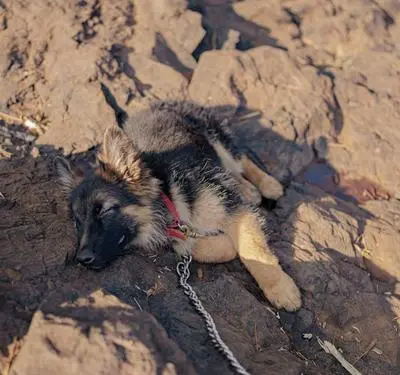
German Shepherd Separation Anxiety — Signs and Solutions
Why German Shepherds get separation anxiety and how to fix it. Covers signs, severity levels, a step-by-step protocol, and a schedule for working owners.
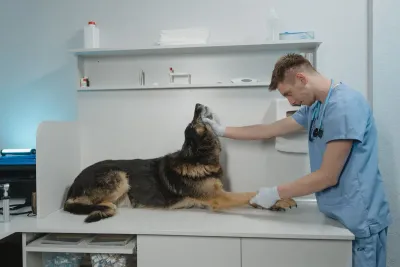
How to Find a Good Vet for Your German Shepherd
How to find a vet who knows German Shepherds: what to look for, what to ask, the specialists that matter, and how to prepare for bloat before it happens.

First-Time German Shepherd Owner Mistakes to Avoid
Experienced German Shepherd owners share the costly mistakes they wish they had avoided. Covers socialization, exercise, feeding, budgeting, and shedding.